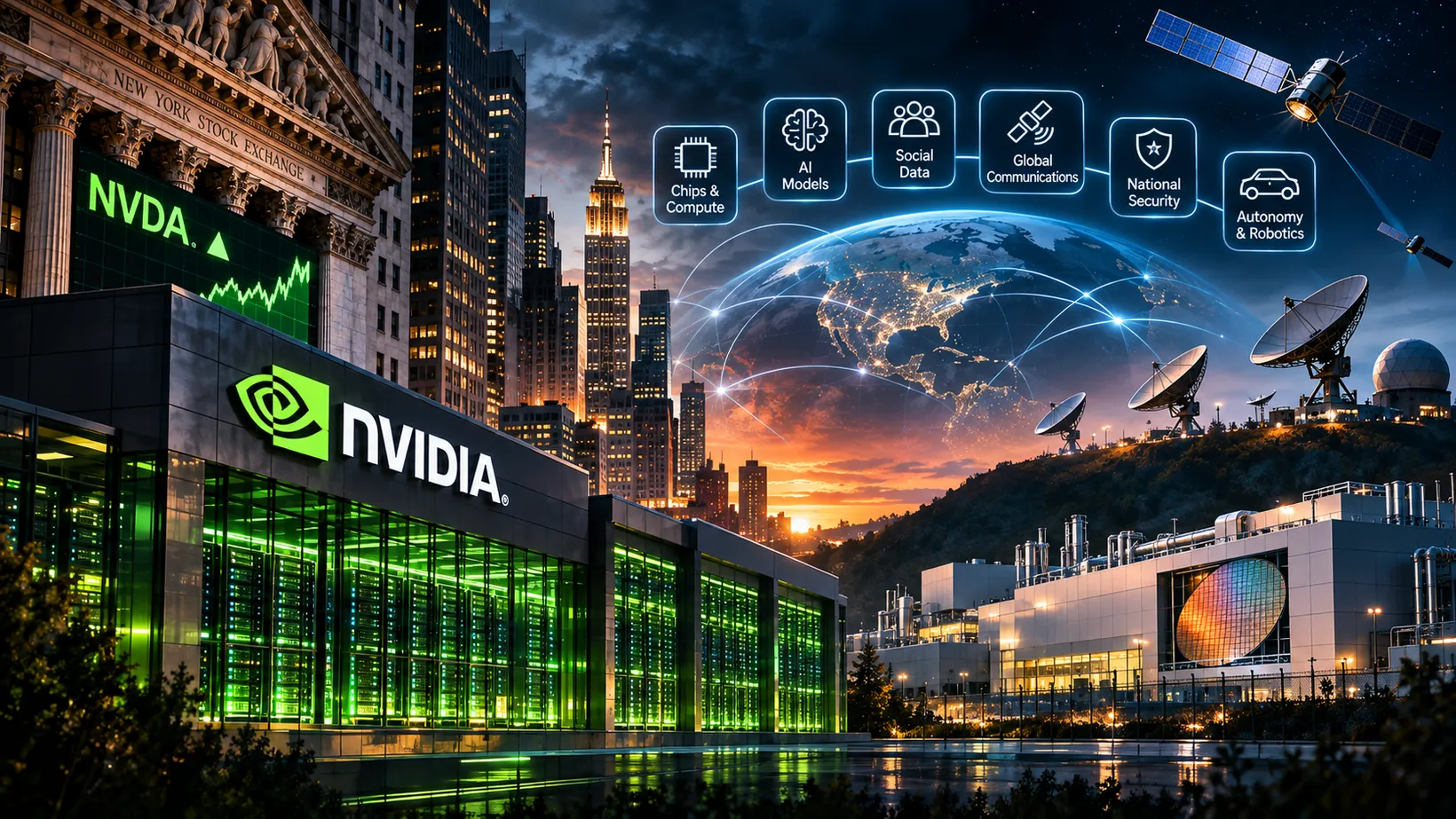
Jensen Huang is out at Nvidia. But the bigger question is whether we’ve allowed too much of AI’s future to depend on too few companies, and too few people.
I’ve been watching Nvidia for years.
Partly because I work in technology.
Partly because I’m fascinated by artificial intelligence.
And partly because it’s hard to ignore a company that’s become so valuable that a bad day for its stock can make the entire market nervous.
On November 12, 2026, Nvidia announced that Jensen Huang had resigned as CEO, president, and board member, effective immediately.
Colette Kress, Nvidia’s longtime CFO, stepped in as interim CEO while the board searches for a permanent replacement.
This wasn’t the carefully choreographed retirement of a founder ready to spend more time golfing.
His departure came after reports involving personal relationships, allegations concerning a possible foreign-intelligence connection, and an independent board investigation.
Those issues are serious, but there’s an important distinction.
Nvidia said it had no reason to believe company secrets or national security had been compromised.
The investigation remains separate from the confirmed fact of Huang’s resignation.
Source: Nvidia Board Statement
But that’s not really what interests me most.
What interests me is that one person leaving one company can create this much uncertainty across an entire industry.
And potentially the American stock market.
Because this isn’t just another technology company changing CEOs.
Nvidia has become one of the foundations of the AI economy.
Which has me wondering whether we’ve put too many eggs in one very expensive, GPU-powered basket.
Nvidia Is Much More Than a Graphics Card Company
If you’re Gen X and grew up around computers, you probably remember when Nvidia meant graphics cards.
Better games.
Higher frame rates.
More realistic explosions.
Spending an unreasonable amount of money so your computer could render shadows nobody was looking at anyway.
Good times.
Then artificial intelligence happened.
Graphics processors turned out to be remarkably effective at the parallel mathematical operations required to train and run AI models.
And Nvidia was positioned to take advantage of it.
But Nvidia didn’t simply build better GPUs.
It built an ecosystem.
CUDA.
AI software libraries.
Networking.
Development frameworks.
Complete data-center systems.
Relationships with virtually every major AI infrastructure provider.
That combination created something competitors can’t easily reproduce by releasing a faster chip.
And the financial results have been extraordinary.
In its fiscal second quarter ending July 26, 2026, Nvidia reported:
- $96.2 billion in quarterly revenue, up 106% year over year.
- $89 billion in data-center revenue, up 117% year over year.
- 75% GAAP gross margin.
- $59.7 billion in quarterly net income.
Source: Nvidia Fiscal Q2 2027 Results
Those aren’t imaginary profits from a company promising to make money someday.
That’s actual revenue.
Actual earnings.
Actual customers.
Which is why I don’t think Huang’s departure automatically means Nvidia is in trouble.
The company still has its technology, engineers, customers, intellectual property, and enormous cash-generating capabilities.
Jensen Huang didn’t personally design every processor or write every line of CUDA.
Thousands of talented people built Nvidia.
But he was also the person who spent 33 years bringing all those pieces together.
Replacing that kind of leadership isn’t as easy as updating someone’s title in Microsoft 365.
Nvidia Is Carrying an Uncomfortable Amount of the Stock Market
Here’s where this becomes more than a technology story.
You don’t need to own Nvidia directly to be exposed to Nvidia.
If you have a retirement account invested in an S&P 500 index fund, there’s a very good chance Nvidia is one of your largest underlying holdings.
On October 28, 2026, Nvidia accounted for approximately 7.82% of the S&P 500 index.
Think about that.
One company.
Nearly eight percent of an index representing roughly 500 large American businesses.
Source: State Street SPDR S&P 500 ETF
Here’s some simple math.
If Nvidia dropped 10% while everything else stayed unchanged, that alone would reduce the index by roughly 0.78 percentage points, assuming that October weight.
That’s not a market prediction.
That’s how market-capitalization weighting works.
And the broader concentration is just as interesting.
Citadel Securities reported in early November that the ten largest companies represented approximately 37% of the S&P 500.
During the third quarter, those ten companies contributed about 3.4 percentage points to the index’s 2.3% gain.
The rest of the index collectively detracted about 1.2 percentage points.
So the biggest companies did more than account for the entire quarterly gain.
Everybody else, collectively, dragged it down.
That doesn’t mean the S&P 500 is broken.
It means an index that looks diversified on paper can still be heavily influenced by a relatively small number of companies.
And Nvidia is right in the middle of it.
The AI Boom Is Helping Drive Corporate Earnings
Nvidia isn’t the only reason the stock market has become so dependent on AI.
The entire infrastructure buildout has become a major economic engine.
Microsoft.
Amazon.
Google.
Meta.
Oracle.
AI cloud providers.
Data-center operators.
Power companies.
Chipmakers.
Memory manufacturers.
Networking vendors.
They’re all participating in an extraordinary investment cycle.
Goldman Sachs Research estimated in September 2026 that AI-related investment was contributing nearly half of S&P 500 earnings-per-share growth that year.
It also projected that the boost would diminish in subsequent years, potentially becoming a modest drag by 2028.
Source: Goldman Sachs Research
That second part is important.
Building AI infrastructure is expensive.
Extremely expensive.
And sooner or later, businesses investing hundreds of billions of dollars need to demonstrate that their AI investments produce enough value to justify the spending.
Some already do.
Others are still figuring out what their billion-dollar data centers are actually supposed to accomplish beyond generating impressive investor presentations.
I believe AI will create enormous value.
But believing in AI doesn’t require believing every AI investment is automatically a good one.
There’s Another Complication: Nvidia Helps Finance the Ecosystem
Nvidia doesn’t simply sell processors to AI infrastructure companies.
It has also invested in some of those businesses.
In January 2026, Nvidia announced an additional $2 billion investment in CoreWeave, alongside an expanded relationship supporting AI data-center development.
There’s nothing inherently improper about that.
Companies invest in customers and strategic partners all the time.
But it creates an interesting financial relationship.
Nvidia invests in an AI infrastructure company.
That company builds infrastructure.
Some of that infrastructure uses Nvidia technology.
Nvidia benefits from the demand.
Again, not necessarily a problem.
But it means the financial relationships supporting the AI boom are becoming increasingly interconnected.
If demand slows, financing becomes more expensive, or customers begin cutting back, the impact may extend well beyond one semiconductor company.
And now the person who coordinated much of Nvidia’s growth and relationships is gone.
That’s worth paying attention to.
Can Nvidia Succeed Without Jensen Huang?
I think the answer is yes.
But that doesn’t mean the transition is risk-free.
In the near term, Nvidia has a substantial advantage.
Its product roadmap was established long before this announcement.
The Vera Rubin platform is in production.
Customers have placed orders.
Manufacturing partners have invested in capacity.
Developers have spent years building around Nvidia’s software ecosystem.
Those things don’t disappear because a CEO resigns.
Nvidia’s board says it expects operations, customer commitments, and the product roadmap to continue without interruption.
That is the board’s expectation, not a guarantee, but there’s good reason to believe the company has significant operational continuity.
Longer term, I have more questions.
Can Nvidia retain its engineering talent?
Can the next CEO maintain important customer relationships?
Will the company remain as aggressive about developing new platforms?
Will its investment strategy change?
And can it keep anticipating where AI computing is going rather than simply defending the business it already has?
Colette Kress is an experienced executive who has been with Nvidia since 2013.
But the permanent leadership decision will matter.
This is a chance for Nvidia to demonstrate that it has become larger than its founder.
A successful transition could actually strengthen confidence in the company’s long-term resilience.
We Need More Competition Than Nvidia and AMD
I want more companies competing to build AI hardware.
Not just Nvidia and AMD.
More.
And there’s a technical distinction worth making here.
Nvidia and AMD are primarily chip designers, not the operators of the advanced fabrication plants that manufacture most of their leading-edge processors.
That manufacturing distinction matters.
We already have several alternatives emerging.
AMD has its Instinct accelerator family and ROCm software ecosystem.
Google has Tensor Processing Units.
Amazon has Trainium.
Microsoft is developing its Maia accelerator family.
Broadcom works with major technology companies on custom AI processors and networking infrastructure.
These aren’t all identical products.
Some are designed for broad commercial availability.
Others are optimized for particular cloud environments.
But they represent growing competition.
In July 2026, AMD announced a partnership with Anthropic involving up to two gigawatts of AMD Instinct MI450 infrastructure, with initial deployment planned for the first half of 2027.
Microsoft has also announced plans to expand its Maia computing systems into multi-gigawatt deployments beginning in 2027.
That’s encouraging.
More competition can create better products, reduce reliance on one software ecosystem, and give businesses more choices.
But here’s the part that concerns me.
Even when companies design different chips, many still depend on the same small group of manufacturers and specialized suppliers.
The Bigger Chokepoint May Be the Supply Chain
Nvidia, AMD, Google, and Amazon can design competing AI accelerators.
But advanced chip manufacturing still depends heavily on companies such as TSMC.
And the processors themselves aren’t enough.
Modern AI systems need high-bandwidth memory.
Advanced chip packaging.
Specialized manufacturing equipment.
Networking.
Power.
Cooling.
An analysis from Epoch AI estimated that Nvidia, Google, AMD, and Amazon collectively consumed more than 90% of global advanced CoWoS packaging capacity and high-bandwidth memory supply in 2025.
That’s an estimate, not a directly audited inventory of global chip production.
But it’s a useful illustration of how concentrated the supporting infrastructure has become.
We can introduce more competing chip designs.
But if everybody depends on the same handful of manufacturing and packaging suppliers, the industry still has significant concentration risk.
A geopolitical disruption.
A manufacturing failure.
Trade restrictions.
Supply shortages.
Any of those can affect multiple chipmakers simultaneously.
More competition in design is good. More resilience throughout the supply chain is better.
Which brings me to Elon Musk.
My Concern About Musk Isn’t Really His Ability to Build Chips
I’ll be transparent.
I’m skeptical of Elon Musk.
Not because I believe everything he’s accomplished is meaningless.
Tesla helped accelerate electric-vehicle adoption.
SpaceX transformed parts of the launch industry.
Starlink provides valuable communications services, including connectivity in locations where traditional infrastructure is unavailable.
Those accomplishments are real.
But technological achievement doesn’t automatically make someone a trustworthy steward of every system they might eventually control.
And Musk’s ambitions are now extending into semiconductor manufacturing.
In October 2026, Musk described plans for Terafab, an advanced manufacturing project involving Tesla and SpaceX.
The goal is to develop manufacturing capacity for AI computing, robotics, and autonomous systems.
Musk discussed a highly ambitious target for volume production in 2028.
He also acknowledged significant uncertainty surrounding that timetable.
There’s nothing wrong with trying to build another advanced chip manufacturer.
I’d welcome more competition.
But announcing a fabrication plant and operating a competitive one are two entirely different accomplishments.
These facilities require extraordinary capital, specialized equipment, engineering expertise, and years of process development.
And producing a working chip once is not the same thing as manufacturing millions at a competitive cost.
That requires reliable yields.
Repeatability.
Manufacturing discipline.
A tremendous amount of experience.
Still, Terafab itself isn’t the part that worries me most.
It’s what happens when you combine semiconductor manufacturing with everything else Musk already influences.
When One Person Controls Too Many Pieces of the Puzzle
Consider the collection of technologies connected to Musk.
X operates a major platform for public conversation, political discourse, and social-media engagement.
xAI develops Grok and increasingly capable AI agents.
Starlink provides satellite communications to consumers, businesses, and governments around the world.
Starshield supports national-security applications, including communications, Earth observation, and government payloads.
SpaceX provides critical launch infrastructure.
Tesla develops autonomous vehicles, robotics, and AI systems.
And now Musk wants to manufacture advanced semiconductors.
Individually, these are important businesses.
Together, they represent something much larger.
A growing concentration of influence over information, communications, computing, and potentially the hardware powering all of it.
That’s where I start getting uncomfortable.
Not because Musk is a billionaire.
Not because he’s successful.
But because combining that much technological influence with questionable judgment and limited public transparency creates legitimate governance concerns.
The issue isn’t simply how much technology one person can build.
It’s how much control one person should have over systems other people depend on.
And whether meaningful oversight exists when something goes wrong.
Ukraine Is Why This Isn’t Just an Academic Concern
One of the clearest examples comes from Ukraine.
Starlink has played a critical role in maintaining communications during Russia’s invasion.
That deserves recognition.
But the same dependence has exposed a difficult governance problem.
In September 2023, Musk publicly acknowledged refusing a Ukrainian request to activate Starlink coverage near Sevastopol, Crimea, for a proposed attack on Russia’s Black Sea Fleet.
Musk argued that enabling the requested coverage could make SpaceX complicit in a major escalation of the war.
Source: Reuters, September 2023
That was a decision about Starlink, not Starshield.
Then, in July 2025, Reuters published an investigation alleging that Musk had ordered coverage disabled in parts of Ukraine during a September 2022 counteroffensive.
The reporting cited people familiar with the alleged order.
SpaceX disputed the account.
The complete circumstances remain contested.
Source: Reuters Investigation, July 2025
Now the issue has become even more immediate.
On November 12, 2026, Ukrainian President Volodymyr Zelenskyy reported renewed restrictions affecting Starshield, SpaceX’s military satellite communications service.
According to Zelenskyy, the restrictions limited use on systems moving faster than approximately 100 miles per hour, interfering with some Ukrainian drone operations.
Ukraine was seeking an explanation from the United States.
Who ordered the latest restrictions remains unclear.
Source: Reuters, November 12, 2026
I’m not claiming Musk personally ordered every disruption.
That hasn’t been established.
And there’s a legitimate national-security argument that military uses of commercial communications infrastructure require contractual limits and government oversight.
But that’s exactly my point.
Why does so much uncertainty exist about who can restrict communications capabilities that a country depends on during a war?
If the U.S. government made the decision, that decision should be accountable to appropriate public institutions.
If SpaceX made it, there should be clear contractual and governmental oversight.
And if the boundary between those authorities is unclear, that’s a problem worth fixing.
Critical infrastructure shouldn’t depend on anyone’s personal judgment alone.
Not Musk’s.
Not the next CEO’s.
Not a government official acting without oversight.
The rules need to be clear before the switch gets flipped.
Now Add the Data
The next concern is information.
And this one gets complicated quickly.
X contains an enormous amount of public conversation and behavioral information.
Public posts.
Engagement.
Reposts.
Profiles.
Interests.
Social relationships.
And interactions with Grok.
X’s own documentation states that public X data and certain Grok interactions may be shared with xAI for training and improving its models, subject to applicable controls and settings.
That’s documented.
Then, in January 2026, Starlink updated its consumer privacy policy to permit certain customer data to be used for AI model training, with opt-out controls.
Reuters reported on the change and the privacy concerns it raised.
Starlink also states that government-account data is not used for AI training and that enterprise customers are automatically opted out.
It says individual browsing histories and geolocation tracking aren’t shared with AI models.
Those distinctions matter.
And to be absolutely clear:
I found no verified evidence that classified Starshield information is being used to train Grok.
I’m not claiming that it is.
But I don’t think we need evidence of the worst imaginable scenario before asking reasonable questions about data governance.
We have an increasingly interconnected corporate ecosystem involving social-media data, consumer communications, AI model development, and national-security services.
Those businesses have different legal and contractual requirements.
Not all of their data is shared.
But who independently verifies the separation?
Who audits which information can move between services?
What data is eligible for model training?
What happens when corporate structures change?
Can users meaningfully understand and control those relationships?
The question isn’t simply whether information is being used improperly today.
It’s whether the boundaries are strong enough, transparent enough, and independently enforceable enough to prevent misuse tomorrow.
Grok’s Safety Record Makes Those Questions More Important
This is another reason I struggle with the idea that we should simply trust Musk’s judgment.
Grok has already faced serious safety controversies.
In early 2026, regulators began investigating reports that Grok had been used to generate nonconsensual sexualized images, including content involving minors.
On February 3, the United Kingdom’s Information Commissioner’s Office announced a formal investigation into X and xAI concerning personal-data processing and safeguards.
The ICO explicitly stated that it had not reached a conclusion about whether data-protection law had been violated.
Source: UK Information Commissioner’s Office
That distinction matters.
An investigation isn’t a conviction.
But the documented safety concerns are relevant.
Especially when the industry is moving from AI that answers questions to AI that can increasingly perform actions.
A chatbot producing harmful content is one category of failure.
An autonomous agent acting with access to communications systems, applications, or sensitive information could create consequences beyond an offensive or inaccurate answer.
That’s why past safety failures should inform the level of oversight we demand as these systems become more capable.
Not because every future product is automatically unsafe.
Because increasing autonomy increases the importance of getting governance right.
The Supervillain Problem Isn’t Really About Supervillains
There’s something about this whole collection of businesses that sounds like a plot from a 1990s science-fiction movie.
One person builds rockets.
Operates a global satellite network.
Controls a major social-media platform.
Develops advanced AI.
Provides national-security communications infrastructure.
Builds autonomous vehicles and robots.
And now wants to manufacture the processors powering all of it.
If somebody pitched that storyline to a Hollywood studio, they’d probably be told to make the villain a little less obvious.
But I’m not arguing Musk is secretly building a superweapon.
That’s not a serious analysis.
The concern isn’t whether Musk wants to become a supervillain.
It’s whether we’re building a system where someone with poor judgment could accumulate supervillain-level influence without sufficient checks and balances.
And here’s how I’d test that concern.
Imagine the exact same combination of companies controlled by someone you deeply distrust.
Would you be comfortable?
Would you trust that person’s judgment about when military communications should remain available?
Would you trust them to maintain meaningful boundaries between consumer information and AI training?
Would you trust them to govern increasingly autonomous AI responsibly?
Would you be satisfied with internal policies and promises as the primary safeguards?
If the answer changes entirely depending on the individual, then we may not have a governance system.
We may have a popularity contest.
And that’s a dangerous way to manage critical infrastructure.
This Isn’t Just an Elon Musk Problem
I want to be consistent.
I’d have the same structural concerns if Zuckerberg controlled all these systems.
Or Bezos.
Or Altman.
Or Huang.
Or any other extremely powerful technology executive.
The issue is concentration.
Musk’s documented decisions and the controversies surrounding his companies make the issue especially urgent for me.
But the underlying danger would exist regardless of the person.
No individual should receive unlimited trust because they built an extraordinary company.
And no corporation should be exempt from oversight because its technology is difficult to replace.
We should be asking for stronger, independently enforceable safeguards.
Clear separation of sensitive data.
Meaningful privacy controls.
Auditable AI training practices.
Independent oversight of critical infrastructure.
Transparent rules governing government and military services.
Competition in communications and computing.
Alternative suppliers.
Contractual protections against arbitrary service interruptions.
And governance structures that don’t depend on a founder personally deciding to do the right thing.
These aren’t anti-innovation ideas.
They’re the things that allow powerful technologies to become dependable institutions rather than remaining personal empires.
What Nvidia and Musk Tell Us About Concentrated Power
I think that’s why Jensen Huang’s departure and Musk’s expanding technology ambitions belong in the same article.
They expose two related but different problems.
Nvidia illustrates economic and technological concentration.
A single company has become enormously important to AI infrastructure, corporate earnings, and the American stock market.
Its CEO leaves, and investors immediately begin questioning how much of the company’s success depended on one person’s vision and relationships.
Musk’s corporate ecosystem illustrates concentration of operational and informational influence.
Communications.
Social data.
AI systems.
National-security contracts.
Launch infrastructure.
Potential semiconductor manufacturing.
Different industries.
Different forms of power.
But the same underlying question.
What happens when too much of society’s technological future depends on a very small group of companies and individuals?
Nvidia’s immediate challenge is succession.
The broader AI industry’s challenge is resilience.
And the Musk question is about governance, ethics, and whether society is maintaining enough independent oversight over increasingly essential systems.
Those concerns overlap.
But they shouldn’t be confused with one another.
What Should We Actually Want From AI’s Future?
I don’t want Nvidia to fail.
I want it to prove it can succeed without Jensen Huang.
I want AMD to compete aggressively.
I want Intel to become a stronger manufacturing competitor.
I want Google, Amazon, Microsoft, and others to continue developing alternatives.
I want better AI hardware.
More manufacturing capacity.
More efficient models.
More open software.
And more choices for businesses and consumers.
I also want AI to keep delivering actual value.
Not just higher stock valuations.
Not just larger data centers.
Not just more expensive GPUs.
Real improvements in productivity, medicine, education, science, security, and daily life.
But I want something else too.
I want people to have meaningful control over how these systems affect them.
I want privacy policies that ordinary human beings can understand.
I want government infrastructure governed by accountable institutions.
I want critical communications to have redundancy.
I want AI companies subjected to independent scrutiny when their products cause harm.
And I want the next generation of technology leaders to understand that building something powerful doesn’t automatically grant them the right to control every consequence of its use.
That’s not anti-business.
It’s basic accountability.
The Future of AI Should Be Bigger Than Any One Company
Here’s where I land.
Jensen Huang helped build one of the most important technology companies in modern history.
That deserves recognition.
But if Nvidia’s future depends entirely on him, then its extraordinary success also created an extraordinary vulnerability.
And the same principle applies to Musk.
It doesn’t matter how wealthy, technically capable, or ambitious someone is.
The future of artificial intelligence shouldn’t become their personal engineering project.
AI is too important for that.
It’s already changing how we work, how businesses operate, how information moves, and how decisions get made.
The next decade may bring changes far more significant than anything we’ve seen so far.
That’s why we need more competition.
More resilient infrastructure.
More transparency.
More independent oversight.
And fewer situations where society has to rely on a billionaire’s personal judgment because nobody thought to create a meaningful alternative.
The future of AI shouldn’t depend on trusting a handful of powerful people to do the right thing.
It should depend on building systems where no individual has enough unchecked power to make the wrong thing catastrophic.
Because I don’t want AI to make a handful of people extraordinarily powerful while everyone else becomes more dependent on them.
I want it to make people more capable.
More informed.
More productive.
And more independent.
That’s the future worth building.
And that’s what Next Is Human is supposed to be about.
The future of AI shouldn’t belong to one company, one government, or one billionaire.
It should belong to humanity.
Sources & Further Reading
- Nvidia’s November 12 announcement confirms Jensen Huang’s resignation, Colette Kress’s appointment as interim CEO, and the search for permanent leadership. Nvidia
- Nvidia’s fiscal second-quarter results provide the company’s revenue, profitability, and AI infrastructure outlook. Nvidia
- State Street documents Nvidia’s October 28 S&P 500 weighting of 7.82%. State Street
- Citadel Securities examines the concentration of the S&P 500 and the contribution of its largest companies to recent market performance. Citadel Securities
- Goldman Sachs Research estimates AI investment’s contribution to 2026 corporate earnings growth. Goldman Sachs
- AMD and Microsoft document expanding competition in AI computing. AMD and Microsoft
- Epoch AI examines the concentration of AI chip packaging and high-bandwidth memory supply. Epoch AI
- Reuters documents SpaceX and Tesla’s Terafab ambitions and Musk’s proposed manufacturing timeline. Reuters
- Reuters reports Musk’s acknowledged refusal to activate Starlink near Crimea in 2023 and its disputed investigation into the 2022 Kherson outage. Reuters, 2023 and Reuters, 2025
- Reuters reports Zelenskyy’s November 12 statements regarding renewed Starshield restrictions and the uncertainty over who ordered them. Reuters
- X and Starlink explain their published policies concerning AI training, consumer data, and opt-out controls. X and Starlink
- The UK’s Information Commissioner’s Office documents its February 2026 investigation into Grok’s personal-data practices and safeguards, while explicitly noting that it had not reached a conclusion on legal violations. ICO