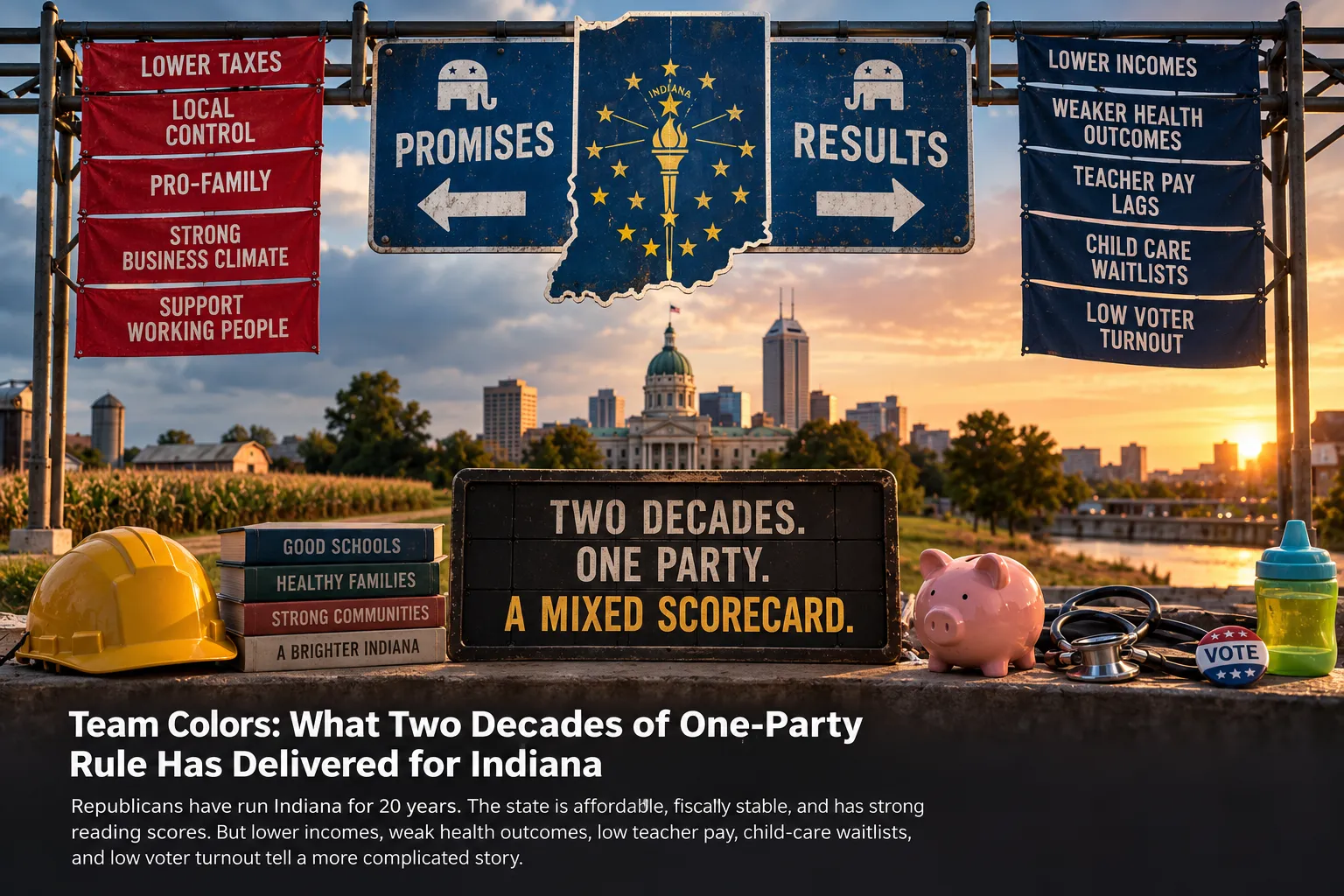
I live here. I lean left. And Republicans have had the keys to Indiana government for a generation. So instead of arguing about jerseys, I went looking for the scoreboard.
I should probably get this out of the way before somebody makes it through three paragraphs, discovers I have opinions, and acts betrayed.
I lean left.
Politically, socially, economically, most of the time I’m going to land somewhere left of Indiana’s center of gravity.
There. Mystery solved.
But this isn’t supposed to be 5,000 words of:
Republicans bad. Democrats good. Please clap.
That would be easy.
It would also be useless.
I wanted to ask a harder question.
What happens when one political party gets enough time and enough power that the results genuinely belong to them?
Indiana is a pretty good laboratory.
Republicans have held the governor’s office continuously since Mitch Daniels took office in January 2005. They took full control of state government after the 2010 election, and today Republicans hold a 70–30 majority in the Indiana House and a 40–10 majority in the Senate. Indiana.gov
For much of that period, they’ve also had supermajorities large enough that Democrats couldn’t stop legislation on their own.
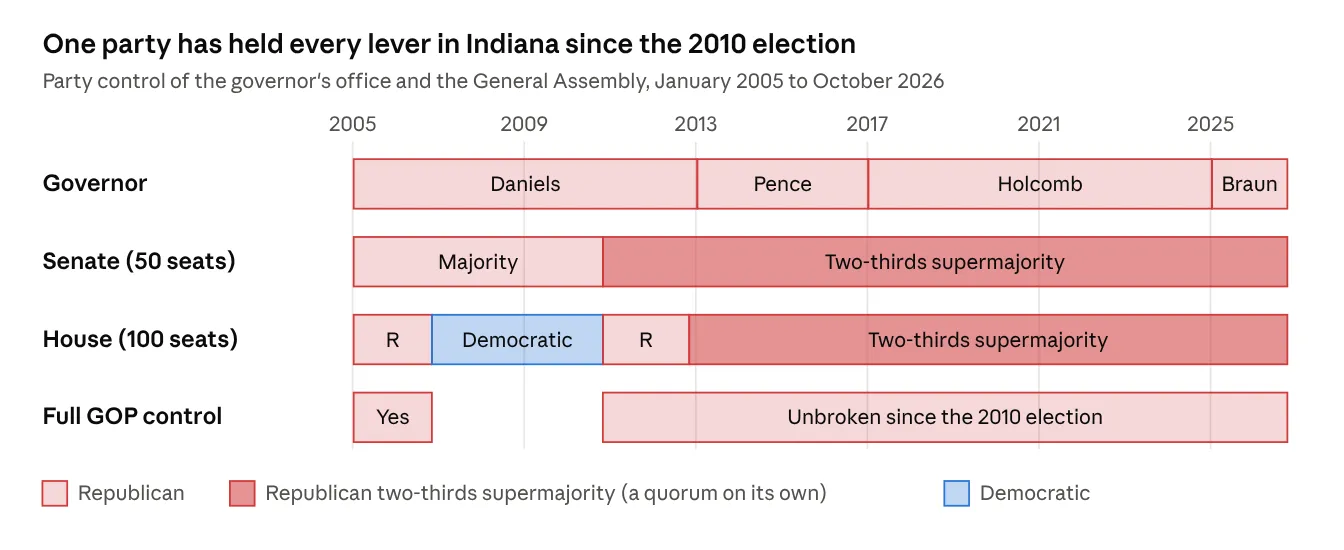
Party control of Indiana state government, 2005 to 2026. Sources: Indiana Historical Bureau, Ballotpedia, IDS News, WFYI.
At some point, you can’t keep campaigning against what the other team might do.
Eventually somebody gets handed the report card.
So I went looking for it.
And, inconveniently for everyone who likes politics neat and tidy, I found things Indiana Republicans deserve credit for.
I also found a lot that should make Hoosiers ask whether winning elections and governing successfully are always the same thing.
First, Let’s Talk About the Jersey
American politics has become increasingly tribal.
We don’t just support our side.
We dislike the other one.
Political scientists have been documenting this for decades under the extremely academic phrase negative partisanship, which is a more dignified way of saying:
I don’t necessarily love my team, but have you seen those assholes over there?
Research finds that Americans’ attitudes toward the opposing party deteriorated dramatically even while feelings toward their own party changed relatively little.
That’s important because once politics becomes identity, the scoreboard gets weird.
A policy from the other team can be bad before we’ve read it.
A policy from our team can become good because somebody handed us talking points explaining why we’re supposed to like it.
Sports fans do this too.
The difference is Peyton Manning never controlled Medicaid funding.
Indiana gives us an unusually clean test because there’s been so little ambiguity about who’s been running things.
Four consecutive Republican governors:
Mitch Daniels.
Mike Pence.
Eric Holcomb.
Mike Braun.
The state archive confirms the Republican run began with Daniels in January 2005. Indiana.gov
And as of 2026, this is the legislature:
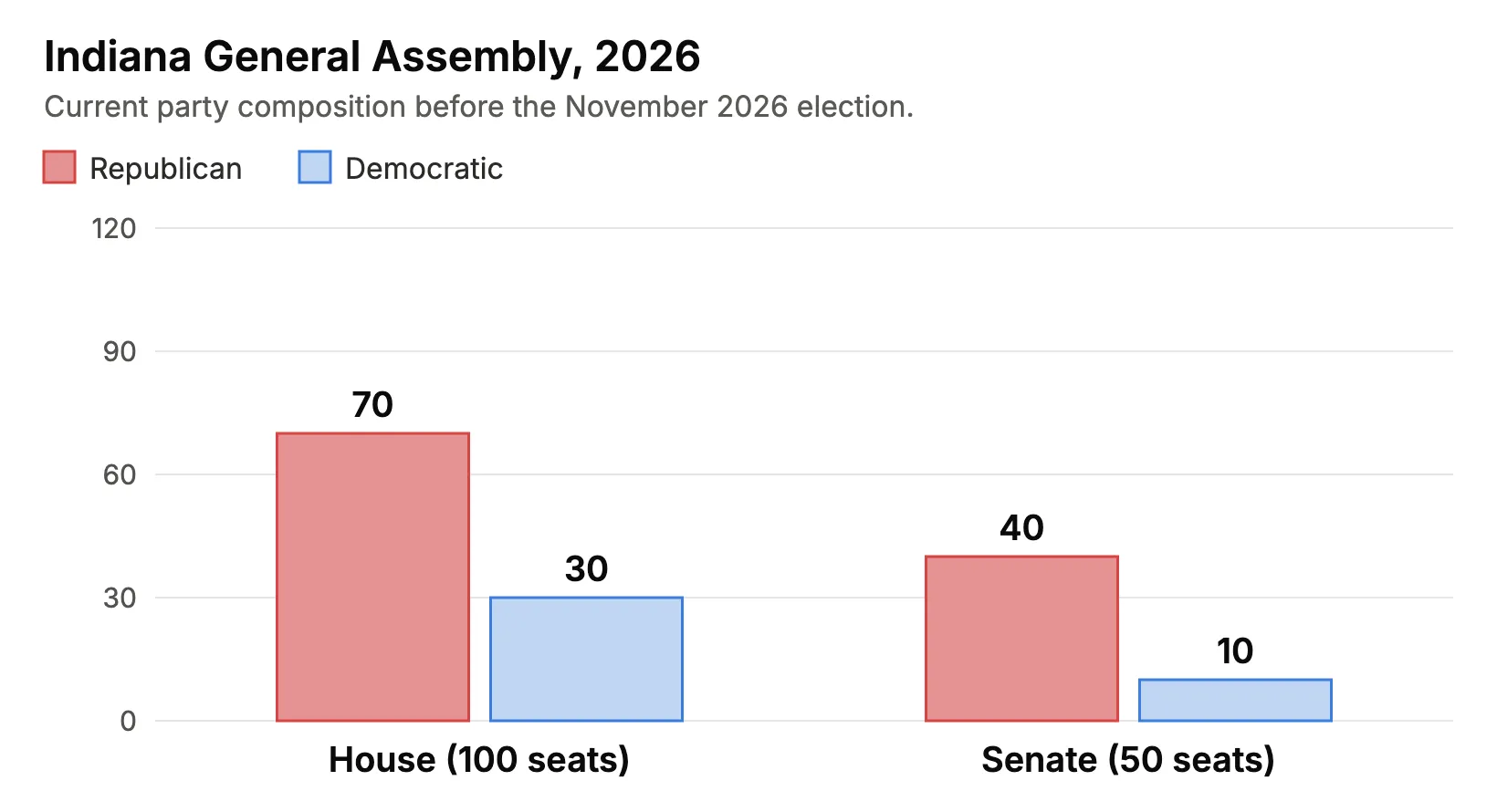
Source: Ballotpedia. Republicans hold supermajorities in both chambers.
That’s not divided government.
That’s ownership.
And Ownership Should Come With Accountability
This is where I think our team-sport mentality gets silly.
If Democrats had controlled Indiana government for 20 years, I would expect Republicans to blame them for Indiana’s outcomes.
And they’d be right to.
Not for everything.
A governor in Indianapolis does not set Federal Reserve policy.
The General Assembly doesn’t control recessions.
It doesn’t decide whether Eli Lilly invents the next blockbuster drug or whether a factory closes because someone in Germany changed global production strategy.
But states absolutely influence:
- education,
- public health,
- tax policy,
- labor law,
- Medicaid,
- child care,
- local government authority,
- environmental regulation,
- voting rules,
- and how public money gets spent.
Those aren’t side quests.
They’re government.
One Recent Fight Shows How Strong the Team Dynamic Has Become
The late-2025 redistricting fight is probably the cleanest example.
Under pressure from President Trump and national Republicans, Indiana lawmakers considered redrawing the state’s congressional districts mid-decade.
The Indiana Senate rejected the proposal 31–19.
What makes that interesting is who killed it.
Twenty-one Republicans joined all ten Democrats to vote it down. Indiana Capital Chronicle
Then came the primary.
Six Republican senators who had opposed the redistricting push lost to Trump-endorsed challengers in May 2026. Ballotpedia described the cycle as a record year for Republican Senate incumbent defeats in Indiana. Ballotpedia News
You can support or oppose the map itself.
The more interesting thing to me is the incentive structure.
When lawmakers in a one-party state face their greatest political danger from inside their own party, governing changes.
The general election isn’t always the accountability mechanism.
The primary is.
And in 2024, 36 of Indiana’s 100 House races had no major-party competition at all. Indiana Public Media
That’s not great for anyone.
Republican.
Democrat.
Libertarian.
Guy who writes “Batman” on every ballot.
Competition is useful.
We generally accept that principle everywhere except politics.
Indiana Voters Aren’t Exactly Throwing Confetti Right Now
Indiana remains a strongly Republican state.
Trump won it comfortably in 2024.
That hasn’t suddenly changed.
But an October 2026 Bellwether Research poll of 839 likely Indiana voters found:
Trump job approval: 44% approve, 54% disapprove.
Gov. Mike Braun: 38% approve, 48% disapprove.
The poll also found nearly 70% opposed new data-center development, while only 18% supported it. Indiana Capital Chronicle
A single poll isn’t holy scripture.
Polls have margins of error.
Question wording matters.
Samples matter.
Voters also don’t necessarily rank every issue equally when they enter the booth.
Still, it’s interesting.
The jersey remains red.
Satisfaction with some of the plays is considerably less enthusiastic.
So What Does the Playbook Actually Say?
This is where I wanted to compare Republican rhetoric with Republican governance.
Not because politicians occasionally fail to live up to campaign language.
Breaking news: politicians have discovered inconsistency.
I wanted to see where the recurring themes line up with policy and where they don’t.
“Local Control”
Indiana Republicans have long emphasized the idea that government closest to the people is generally best.
I actually agree with that more often than not.
Yet Indiana has repeatedly preempted local governments when local policy moved somewhere state lawmakers didn’t want it to go.
Cities can’t establish their own higher minimum wage.
Indiana’s minimum wage remains $7.25 an hour, where it has been since July 2009. Indiana.gov
The state has also restricted local authority in areas ranging from landlord-tenant rules to other municipal regulation.
Then came the 2025 property-tax overhaul.
Supporters correctly describe it as tax relief.
Homeowners do receive relief.
But fiscal analysis projected that local governments would collect roughly $1.5 billion less over three years than under prior law, including about $744 million less for school corporations. Republican leaders countered that many local units would still see revenue rise year over year, just more slowly than under previous law. Indiana Capital Chronicle
That’s the sort of nuance worth keeping.
It can simultaneously be:
real property-tax relief
and
a real constraint on local government revenue.
Government is annoying that way.
“Pro-Family”
Indiana’s abortion policy is straightforwardly conservative.
After Dobbs, Indiana became the first state to enact a new near-total abortion ban, with limited exceptions including rape or incest early in pregnancy, serious health or life risks, and certain lethal fetal abnormalities. AP News
If you believe life begins at conception, that policy can make complete philosophical sense.
Where I struggle is what happens after birth.
Indiana has no broad statewide paid family-leave program.
And child care has become a mess.
By February 2026, 35,397 children were on Indiana’s child-care voucher waiting list. Braun’s administration subsequently secured a $200 million one-time infusion intended to move roughly 14,000 children off that list. WFYI
That’s worth crediting.
It also means more than half the waiting list remained.
Public health tells another uncomfortable story.
Indiana created Health First Indiana in 2023 and funded it at $75 million in 2024 and $150 million in 2025. That was a serious investment. Indiana.gov
Then the 2025 budget cut the statewide appropriation to $40 million annually for 2026 and 2027. Indiana.gov
That’s roughly a 73% reduction from the 2025 level.
Meanwhile, Indiana’s own Maternal Mortality Review Committee concluded that 83% of pregnancy-associated deaths reviewed for 2022 were preventable. Indiana.gov
This is where my own leftward bias shows.
If we’re going to call public policy “pro-family,” I think the scoreboard should continue after delivery.
Child care.
Maternal health.
Medical care.
Schools.
Food.
Being pro-family has to mean supporting families after the baby is born, too.
“Fiscal Responsibility”
Here’s where Republicans deserve real credit.
Indiana is fiscally conservative.
Not in the campaign-slogan sense.
In the bond-rating sense.
The state maintains strong reserves and top-tier credit ratings.
Indiana also keeps taxes relatively low.
The Tax Foundation, which generally favors lower and more structurally neutral taxes, ranks Indiana 10th nationally in its 2026 State Tax Competitiveness Index. Tax Foundation
The state income-tax rate fell to 3% in 2025 and is scheduled to reach 2.9% by 2027. Tax Foundation
If your priorities are:
- low taxes,
- business friendliness,
- budget reserves,
- and low unemployment,
Indiana has a real case to make.
But tax competitiveness isn’t the same question as who carries the burden.
ITEP, a left-leaning tax-policy group, estimates that Indiana’s lowest-income 20% pay 13.3% of their income in state and local taxes, while the top 1% pay about 6.2%, ranking Indiana’s system the 14th most regressive under its methodology. ITEP
Two ideologically different organizations can therefore look at the same state and conclude:
Indiana’s tax structure is very competitive.
and
Indiana’s tax structure is regressive.
Both can be true because they’re measuring different things.
Which is disappointingly mature for political discourse.
“Working People”
Indiana’s Republican platform talks proudly about working men and women.
Again, great.
Let’s check the record.
Indiana became a right-to-work state in 2012. The current law prohibits requiring union membership or dues as a condition of employment. Indiana.gov
In 2015, lawmakers repealed Indiana’s Common Construction Wage law, the state’s prevailing-wage requirement for many public construction projects. Indiana.gov
And the minimum wage?
Still $7.25.
Since 2009. Indiana.gov
Indiana’s 2025 union membership rate was 8.3%, compared with 10% nationally. Bureau of Labor Statistics
None of those policies automatically proves workers are worse off.
Right-to-work supporters argue workers shouldn’t be compelled to financially support a union.
Prevailing-wage opponents argue government construction should be exposed to more price competition.
Minimum-wage critics worry about labor-market effects.
Those are legitimate arguments.
But they’re also clearly policy choices about where bargaining power sits.
And after two decades, we can look at the outcomes.
Paychecks Haven’t Exactly Caught Fire
Indiana is inexpensive.
That’s genuinely valuable.
A dollar goes further here than in Boston or Seattle.
But low costs are only half of affordability.
The other half is income.
In 2024, Census data put Indiana’s median household income at $71,959, compared with $81,604 nationally. Census Data
Against the comparison states used in my research:
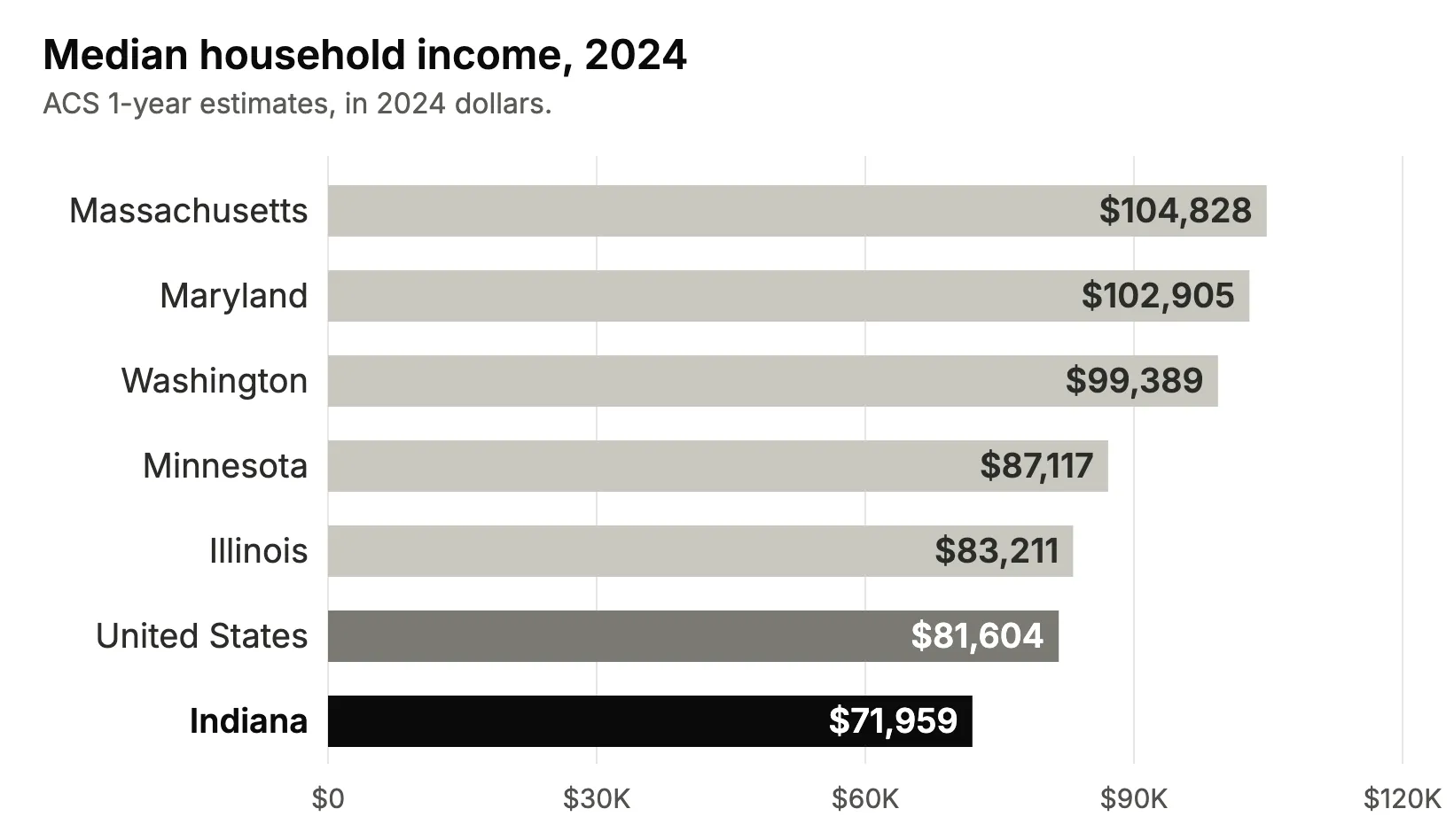
Source: U.S. Census Bureau, 2024 ACS.
Indiana’s lower cost of living narrows that gap.
It does not erase it.
That’s an important distinction because “Indiana is cheap” can become a way of avoiding the other side of the equation:
Why aren’t Hoosier incomes catching up?
And This Trend Didn’t Start With Republicans
This is one of the places where I don’t want to cheat.
Indiana’s relative income slide began before Mitch Daniels.
The trend was already moving the wrong direction around 2000, under Democratic governors Frank O’Bannon and Joe Kernan.
So blaming the entire income gap on Republican rule would be dishonest.
But here’s the other side:
Republicans have now had two decades to reverse it.
They haven’t.
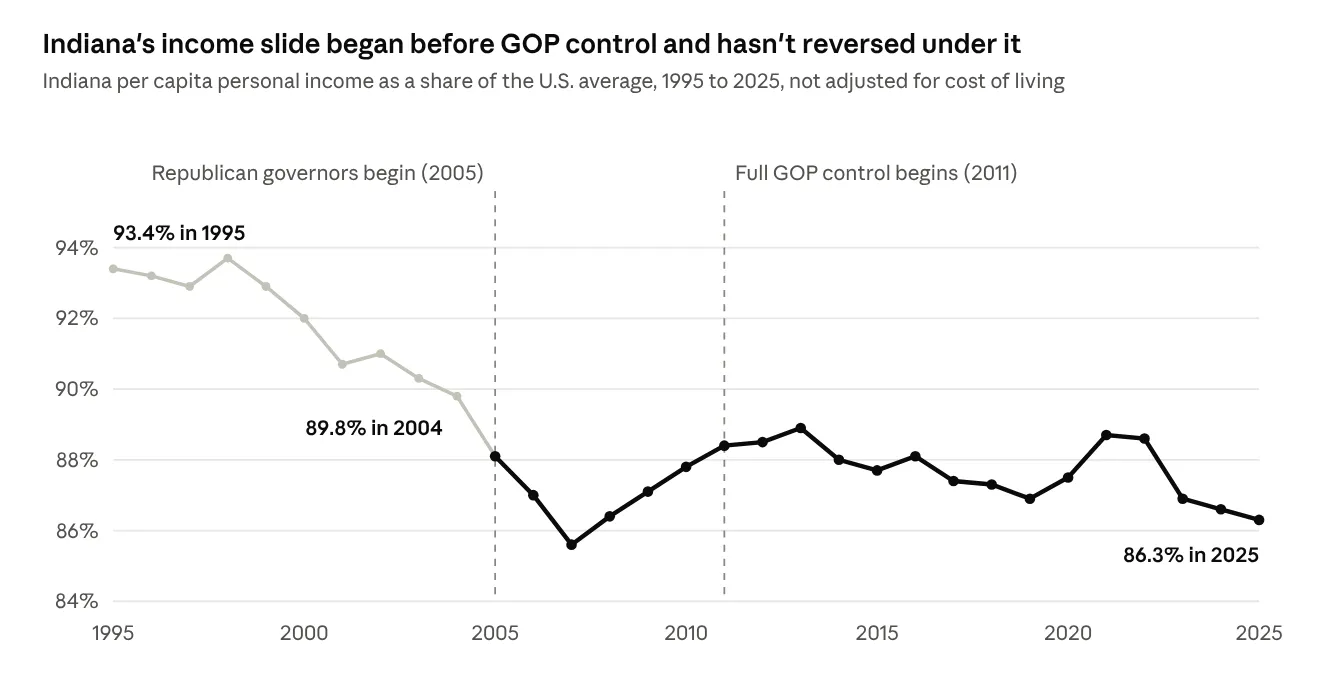
Source: BEA per capita personal income for Indiana and the U.S. (national accounts basis), via FRED, 1995 to 2025.
That’s the accountability question.
Not:
Did Republicans personally invent every Indiana problem?
No.
It’s:
After twenty years of control, which problems got meaningfully better?
Schools Are One of the More Interesting Mixed Results
Indiana’s K-12 story is not simply bad.
In fact, parts of it are quite good.
Indiana students performed strongly on the 2024 NAEP, with fourth- and eighth-grade reading results placing the state among the country’s best performers.
That’s something worth celebrating.
Kids learning to read is generally preferable to kids not learning to read.
Bold position, I know.
Teacher compensation is less impressive.
NEA puts Indiana’s 2024–25 average teacher salary at $61,661, ranking 38th nationally. National Education Association
Here’s the same comparison set:
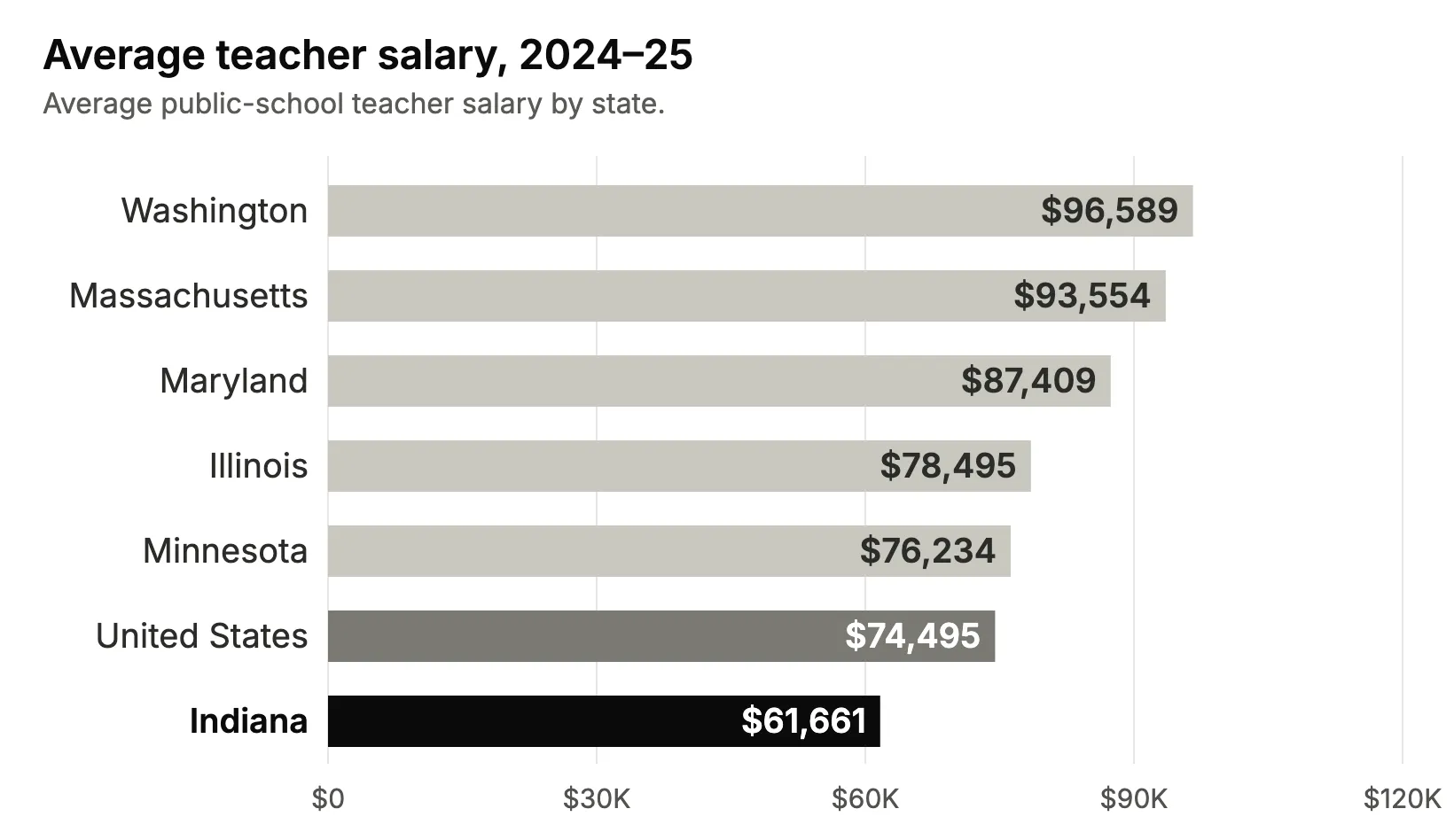
Source: National Education Association, Rankings & Estimates 2026.
Then there’s school choice.
Indiana has expanded its voucher program repeatedly.
For 2024–25, the later reconciled state figure shows about $491 million in actual Choice Scholarship payments. In 2025–26, spending rose to $548 million. Chalkbeat
And the program has increasingly reached higher-income households.
In 2025–26, roughly 7,000 students from families earning more than $200,000 received vouchers, while the number from households under $50,000 fell compared with the prior year. Chalkbeat
If you believe public education dollars should follow the child regardless of family income, that’s consistent policy.
From where I sit on the left, I have a harder time explaining why public resources should subsidize private-school tuition for families earning $200,000 while teacher pay remains 38th and public schools are worrying about hundreds of millions in projected local revenue losses.
That’s an ideological disagreement.
But at least we’re arguing about the actual tradeoff.
Higher Education Got a Pretty Significant Shake-Up Too
Indiana’s 2025 higher-education reforms pushed public universities to review low-enrollment degree programs.
The initial announcement described 408 affected programs.
The Commission for Higher Education later revised that count to 404:
74 eliminated.
101 suspended or committed to suspension.
229 merged or consolidated. Indiana.gov
The commission argues the changes streamline degree offerings and better align programs with workforce demand.
That’s not an absurd goal.
Universities shouldn’t operate programs indefinitely just because nobody wants to be the person who shuts them down.
But it also represents a larger philosophy running through Indiana government:
Higher education is increasingly evaluated through economic utility.
I understand that.
I also think a university’s value is bigger than producing the precise worker profile an employer happens to need next quarter.
Those two ideas will continue annoying each other indefinitely.
Health Is Where the Scoreboard Gets Harder to Defend
This is the section that bothered me most when I worked through the data.
Indiana ranked 37th overall in America’s Health Rankings’ 2025 report. America’s Health Rankings
Public-health spending?
$73 per person.
Rank:
48th. America’s Health Rankings
And life expectancy tells a much more human story than rankings do.
According to CDC’s 2022 state life tables:
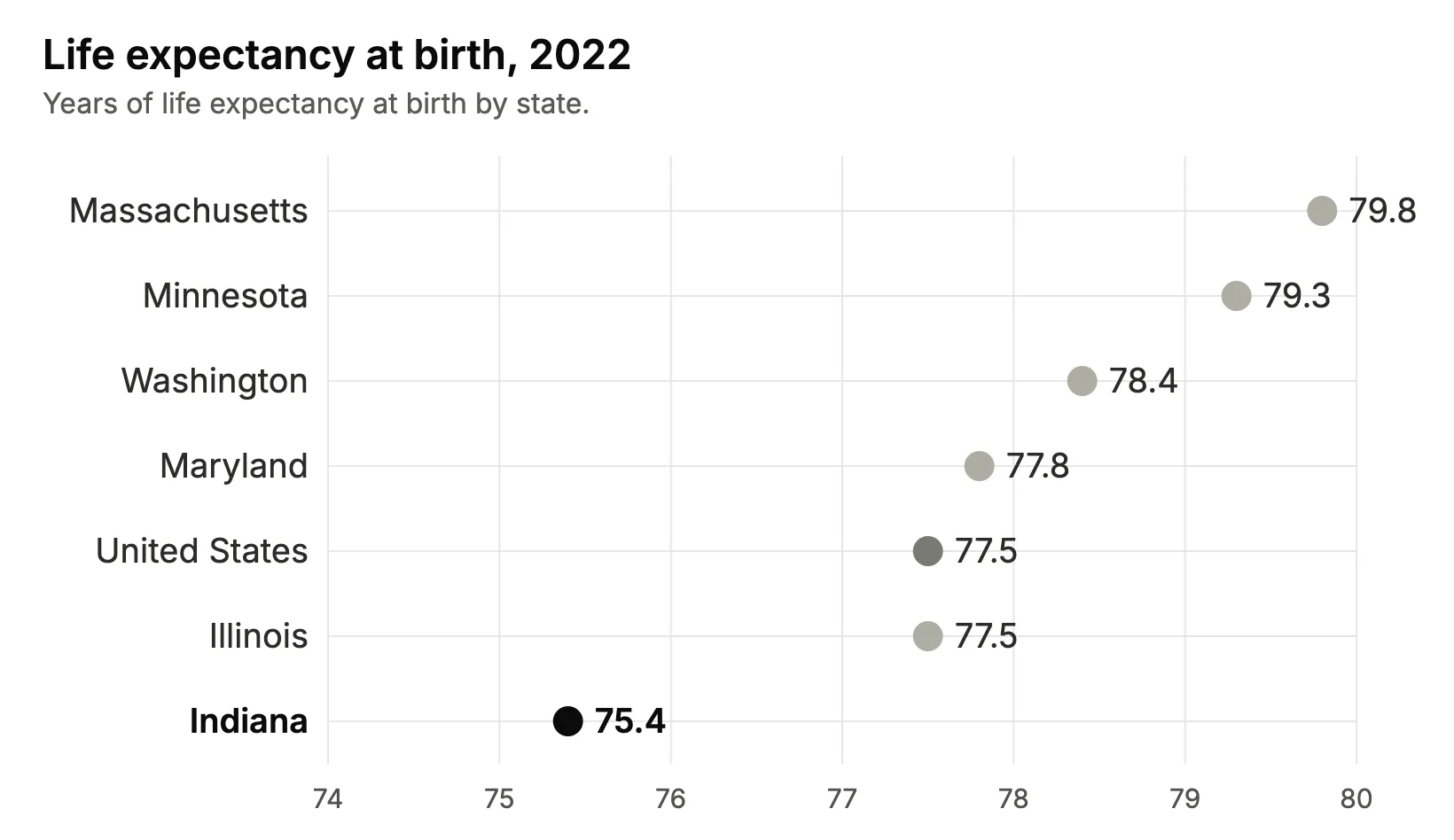
Source: CDC/NCHS U.S. State Life Tables, 2022.
A child born in Indiana in 2022 had a life expectancy about four years shorter than one born in Massachusetts. CDC
Four years.
Not four ranking positions.
Years.
This is where political arguments get less entertaining.
No, Government Doesn’t Control Every Health Outcome
A fair conservative response would be:
People smoke.
People drink.
People eat badly.
People don’t exercise.
Government doesn’t determine every personal choice.
Correct.
Absolutely.
Indiana also has an economy heavily shaped by manufacturing, different demographics, different population density, and a different cost structure than Massachusetts.
Those things matter.
But public policy isn’t irrelevant either.
Indiana decides how much it invests in public health.
Whether people can access Medicaid.
How tobacco is taxed.
What maternal-health programs receive funding.
How preventive care is supported.
Indiana’s Health First program itself is built on the premise that public investment can improve community health. Indiana.gov
We can’t simultaneously say:
Government can’t affect health.
and
Look at this government program we created to improve health.
Pick a lane.
Medicaid Is Another Good Example of the Difference Between Policy and Slogan
Mike Pence deserves credit here.
In 2015, while many Republican-led states rejected Medicaid expansion outright, Indiana expanded coverage through the conservative-designed HIP 2.0 program.
That’s a genuine Republican policy success from my perspective.
Now the state is moving toward work requirements.
Beginning January 1, 2027, most affected HIP members will need to satisfy an 80-hour monthly work, education, training, or community-service requirement unless they qualify for an exemption. Indiana.gov
As of October 5, 2026, FSSA estimated more than 58,000 members weren’t currently meeting the pending requirement. Indiana.gov
Supporters frame that as responsibility.
Critics worry about eligible people losing coverage because of reporting bureaucracy rather than an actual unwillingness to work.
We won’t know the full outcome until the policy is operating.
So I’ll resist the popular internet tradition of declaring victory or catastrophe before implementation.
Put it on the scoreboard.
Measure it.
Then judge it.
Indiana Does Some Things Really Well
If I’m going to criticize two decades of Republican rule, I have to give the same government credit where the evidence supports it.
And there are real wins.
Low unemployment
Indiana’s August 2026 unemployment rate was 3.3%, compared with 4.1% nationally. Bureau of Labor Statistics
Among the comparison states in this article:
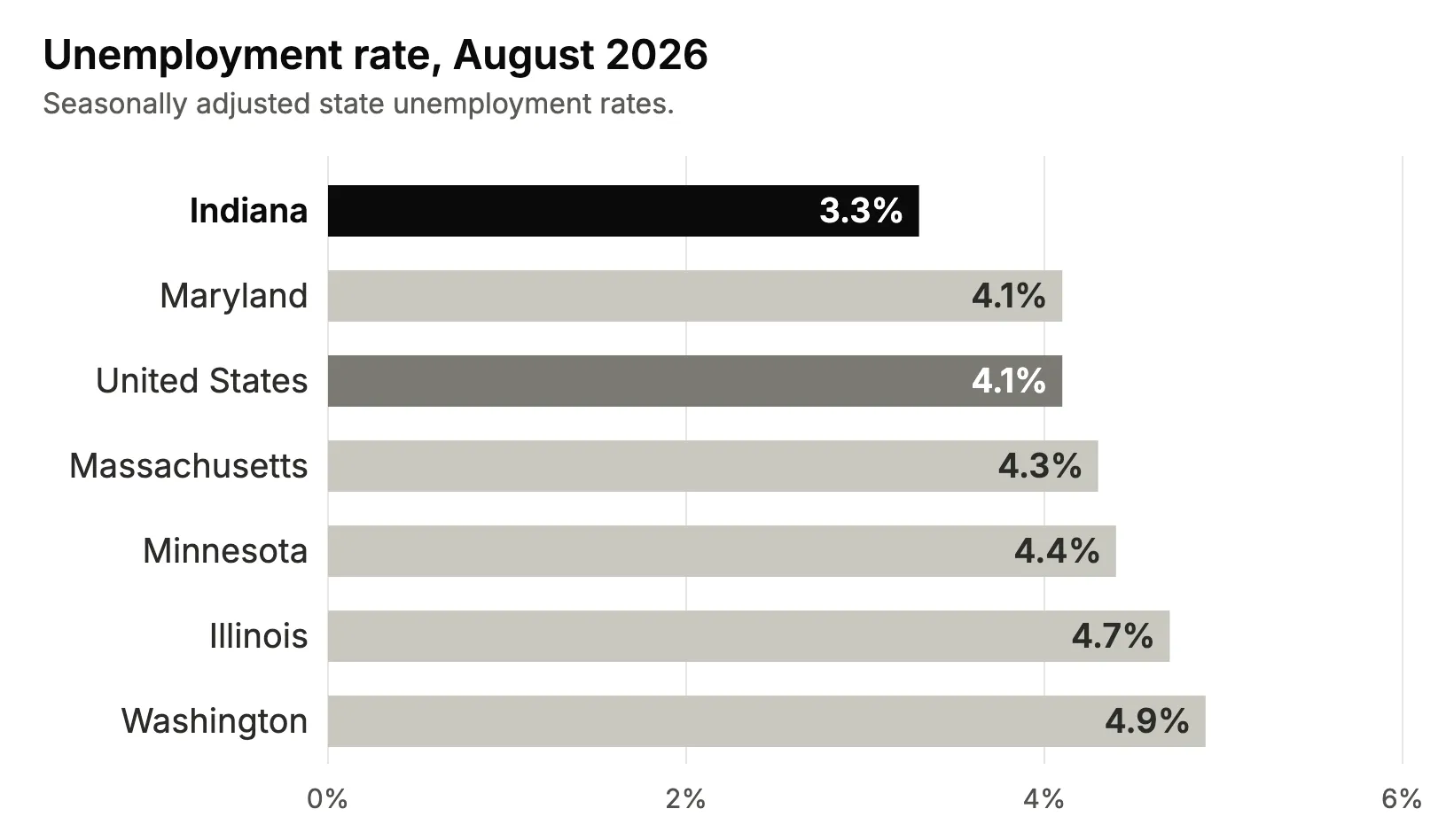
Source: U.S. Bureau of Labor Statistics. August 2026 figures are preliminary.
That’s good.
Full stop.
Strong fiscal management
Indiana’s long-running emphasis on reserves, creditworthiness and conservative budgeting is not imaginary.
Low cost of living
Indiana remains cheaper than the national average, which materially improves what a paycheck buys. BEA’s regional-price-parity data are specifically designed to capture that difference. Bureau of Economic Analysis
Reading performance
Indiana’s students have posted legitimately strong reading results.
Business environment
The Tax Foundation ranks Indiana 10th on tax competitiveness. Tax Foundation
Violent crime
Indiana’s violent-crime rate is below the national rate in the comparison data used here.
Those aren’t footnotes I’m including because someone from the Statehouse forced me to.
They’re part of the record.
That’s Actually What Makes the Weak Areas More Frustrating
Indiana has demonstrated that it can set a goal and execute.
Want strong reserves?
Done.
Want low taxes?
Done.
Want a business-friendly regulatory climate?
Done.
Want school choice?
Done, and then some.
Want right-to-work?
Passed.
Want permitless carry?
Passed.
When Republican leadership sees something as a priority, Indiana government is remarkably capable of moving.
That’s why:
- 48th in public-health spending,
- 38th in teacher pay,
- low household income,
- low voter turnout,
- and poor health outcomes
can’t endlessly be explained as unfortunate weather.
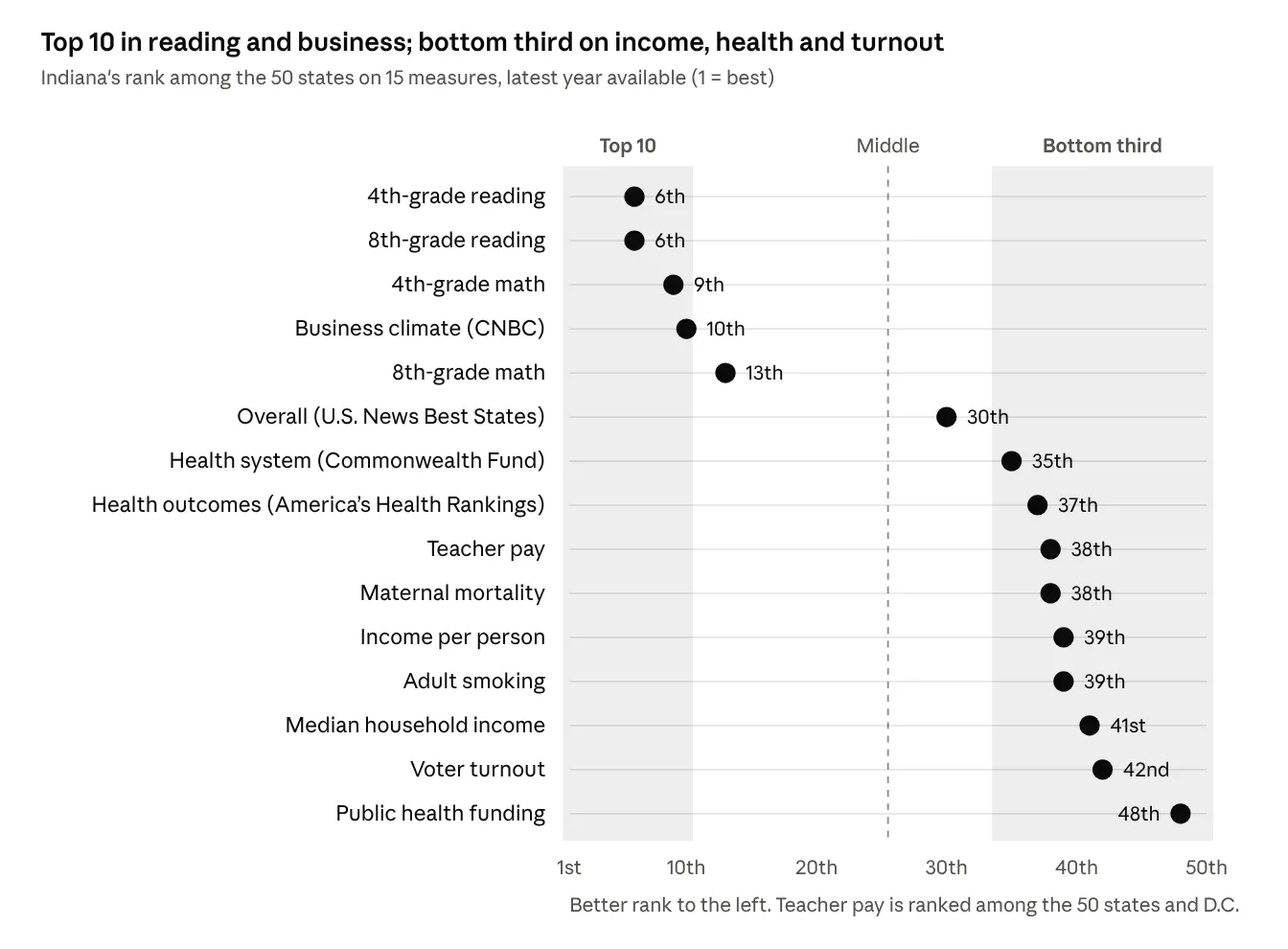
Sources: NAEP 2024 (Indiana Department of Education), CNBC 2026, U.S. News 2026, Commonwealth Fund 2025, America’s Health Rankings, NEA, BEA, Census ACS 2024, UF Election Lab. Teacher pay is ranked among the 50 states and D.C.
Two decades is enough time to ask why some things received urgency and others received patience.
The Comparison With Democratic-Led States Is Useful, but It Isn’t a Science Experiment
I deliberately compared Indiana with several states that have had long periods of Democratic leadership:
Minnesota.
Illinois.
Washington.
Massachusetts.
Maryland.
I did that because I wanted to test my own left-leaning assumption.
If progressive policy produces better quality-of-life outcomes, I’d expect to see some evidence.
On many measures, I did.
Those states generally have:
- higher household incomes,
- higher teacher pay,
- higher union membership,
- longer life expectancy,
- and higher voter turnout.
But here’s the caveat in 72-point font:
Correlation is not causation.
Massachusetts did not become wealthy because somebody elected a Democrat last Tuesday.
Washington has Amazon and Microsoft.
Maryland benefits enormously from proximity to Washington, D.C.
Massachusetts has an unusually educated workforce and world-class universities.
Illinois has Chicago.
Minnesota’s political history doesn’t even fit the comparison as neatly as the others.
Meanwhile, Indiana is one of the country’s most manufacturing-intensive economies.
Starting conditions matter.
Industry mix matters.
Geography matters.
Demographics matter.
The comparison tells us how states differ.
It does not prove that a party label caused every difference.
Anyone claiming otherwise is trying to sell the chart harder than the chart deserves.
Indiana Also Started Behind
This is another point conservatives are right to raise.
When the current Republican era began, many of these Democratic-led states already had higher incomes and better health outcomes.
Indiana didn’t fall from first place after Mitch Daniels took office.
Some of the gap is inherited.
And the income decline relative to the nation started during Democratic administrations.
I don’t think acknowledging that weakens the argument.
It makes the argument honest.
The question is not:
Why didn’t Republicans turn Indiana into Massachusetts overnight?
It’s:
After twenty years, did the gap close?
On many of the measures that matter most to me, the answer is no.
The Tax Debate Is Almost a Perfect Summary of Indiana
Indiana’s tax system might be the cleanest illustration of the state’s broader governing philosophy.
Tax Foundation:
10th-best tax competitiveness. Tax Foundation
ITEP:
14th-most regressive state and local tax system. ITEP
Those sound contradictory.
They aren’t.
One organization asks:
How economically competitive and structurally efficient is the tax code?
The other asks:
How much of people’s income do different income groups pay?
Indiana answers:
Very competitive.
and
Lower-income households pay a larger share of their income than the wealthy.
That’s basically the entire philosophical debate in miniature.
Indiana Republicans prioritize keeping the state inexpensive, fiscally stable and attractive to capital.
From the left, my question is whether we’re equally aggressive about making Indiana attractive to people.
Those aren’t necessarily opposing goals.
I wish we acted like that more often.
We Should Talk About Voting Too
Indiana’s 2024 voting-eligible-population turnout was 59.05%.
The national rate was about 64%.
Minnesota was 76.5%.
Washington 70.2%.
Maryland 69.4%.
Massachusetts 68.4%.
Illinois 63.5%. UF Election Lab
Indiana also closes Election Day polls at 6 p.m., unusually early compared with much of the country.
It requires voter identification.
Mail voting is more restricted than in many states.
Again, each policy has arguments behind it.
But if the actual civic outcome is low participation, I think that’s worth caring about regardless of party.
Democracy is one of the few products where declining customer participation shouldn’t be considered an efficiency gain.
Maybe Local Journalism Matters More Than We Think
There’s another reason state accountability gets harder.
People know considerably more about national politics than state politics.
We know what the president tweeted.
We know what somebody in Congress said on cable news.
Ask which committee changed Indiana’s public-health budget?
Suddenly we’re all checking our phones.
Local-news decline makes that worse.
When nobody is watching the statehouse, politics becomes even more about national identity.
People vote Republican or Democrat, not:
I reviewed the fiscal note for Senate Enrolled Act 1 and have some concerns about municipal revenue growth.
Admittedly, that slogan would look terrible on a yard sign.
But the consequences are local.
“Against Their Own Interests” Is Too Easy
Here’s another place where I think people on the left need to be less condescending.
It’s tempting to look at rural or working-class Republican voters and say:
They’re voting against their own interests.
I don’t particularly like that argument.
Who appointed me Chief Executive Officer of Somebody Else’s Interests?
People have values beyond income.
Abortion.
Religion.
Guns.
Immigration.
Culture.
Taxes.
Individual freedom.
National identity.
Someone can knowingly accept an economic tradeoff because another issue matters more to them.
We all do versions of this.
Wealthy Democrats sometimes vote for politicians promising to raise their taxes.
That’s not voting against their interests.
It’s defining their interests differently.
So my argument isn’t:
Republican voters are stupid.
It is:
When one party governs for twenty years, voters should be willing to judge that party on outcomes instead of only intentions.
I would say exactly the same thing about Democrats.
And the Polling Suggests Plenty of Republicans Are Capable of Doing That
Remember that failed redistricting vote?
Twenty-one Republican senators broke with enormous pressure from their own party.
That’s worth respecting.
Some lost their jobs over it.
Indiana Republicans created Health First Indiana.
Pence expanded Medicaid.
Indiana has maintained disciplined finances.
The state has strong reading scores.
These weren’t accidents.
They’re Republican governance too.
This isn’t a superhero movie.
One party doesn’t exclusively wear the cape.
The other doesn’t spend all day tying women to railroad tracks.
Mostly.
But the Scoreboard Still Matters
After twenty years, here’s where I land.
Indiana is financially stable.
It’s affordable.
Its unemployment rate is low.
It has a strong business climate.
Its kids perform particularly well in reading.
Those are real accomplishments.
But Hoosiers also earn less than the national median.
Teachers make considerably less than peers in the comparison states.
Our public-health investment is near the bottom of the country.
Life expectancy is poor.
Maternal deaths remain deeply concerning.
Child-care access has required emergency funding.
Union membership is below the national average.
The state’s minimum wage hasn’t moved in seventeen years.
And voter turnout remains weak.
That’s not a record I can look at and conclude:
Everything’s fine. Keep arguing about Washington.
One-Party Rule Has a Cost Even When You Like the Party
This may actually be the biggest thing I took from all of this.
I don’t think prolonged one-party control is particularly healthy.
Even when it’s my party.
Competition creates accountability.
If Democrats knew Indiana could genuinely flip, Republicans would have to compete harder for voters outside their base.
And Democrats would have to offer something better than:
Have you considered that we’re not Republicans?
Everyone improves when losing is possible.
Businesses understand competition.
Republicans talk about competition constantly.
Maybe politics could use some too.
The Jersey Isn’t the Scoreboard
I understand why politics becomes tribal.
I have a jersey too.
But the jersey is supposed to represent something.
For me, government should help create conditions where ordinary people can:
- build a decent life,
- raise a family,
- get healthcare,
- educate their kids,
- earn enough to live,
- breathe reasonably clean air,
- and have a meaningful voice in the system governing them.
That’s a left-leaning definition.
I’m not pretending otherwise.
Someone on the right may put more weight on:
- low taxation,
- individual responsibility,
- limited regulation,
- gun rights,
- religious liberty,
- and economic freedom.
Fine.
That’s democracy.
But sooner or later, governing philosophies need to produce measurable outcomes.
Otherwise politics becomes fandom.
And we already have the Colts for that.
Twenty Years Is Long Enough to Own the Results
That’s ultimately what this is about.
Indiana Republicans have had extraordinary political success.
Four governors.
Legislative control.
Supermajorities.
The ability to enact most of their agenda without Democratic votes.
They deserve credit for what worked.
They also own what didn’t.
Not because Republicans are uniquely bad.
Because that’s what governing means.
You don’t get to take credit for:
- the AAA rating,
- low unemployment,
- reading scores,
- and tax competitiveness,
then treat:
- poor health,
- low wages,
- teacher pay,
- public-health underinvestment,
- and low turnout
as mysterious acts of God.
The scoreboard belongs to the team on the field.
And after two decades, Indiana’s scoreboard is mixed.
Some of it is genuinely good.
Some of it should bother us.
A lot.
The part I care about most is whether Hoosiers’ lives are actually getting better.
Not whether our side won another election.
Not whether someone owned the libs.
Not whether someone owned the conservatives.
Whether people live longer.
Earn more.
Have healthy children.
Can afford child care.
Can find a teacher who hasn’t burned out and moved to another state.
Can participate in elections.
Can build something here and want to stay.
That’s government.
Everything else is merchandise.
And maybe the healthiest thing we could do for Indiana politics isn’t switch jerseys.
It’s remember that we’re supposed to be watching the scoreboard.
Source notes
- The political-control timeline is grounded in Indiana’s state archives and current legislative composition data. Indiana.gov
- The 2026 polling figures come from Bellwether Research’s October 8–11 survey of 839 likely Indiana voters, as reported by the Indiana Capital Chronicle. Indiana Capital Chronicle
- The education figures use Indiana’s 2024 NAEP performance and NEA’s 2024–25 teacher-pay estimates. National Education Association
- Health figures use CDC state life tables, America’s Health Rankings and Indiana Department of Health materials. CDC
- Income data are from the Census Bureau’s 2024 American Community Survey; unemployment and union-membership figures are from BLS. Census.gov
- Child-care figures reflect the 35,397-child February 2026 waitlist and the later $200 million emergency appropriation intended to fund roughly 14,000 additional placements. WFYI
- The higher-education program count uses the Indiana Commission for Higher Education’s corrected 404-program figure rather than its earlier preliminary 408 count. Indiana.gov
- The school-voucher figure uses the later reconciled approximately $491 million in 2024–25 payments and the state’s reported $548 million for 2025–26. Chalkbeat
- Health First Indiana funding is shown at $150 million for 2025 and $40 million annually for FY 2026 and FY 2027. Health First Indiana · Indiana State Budget Agency