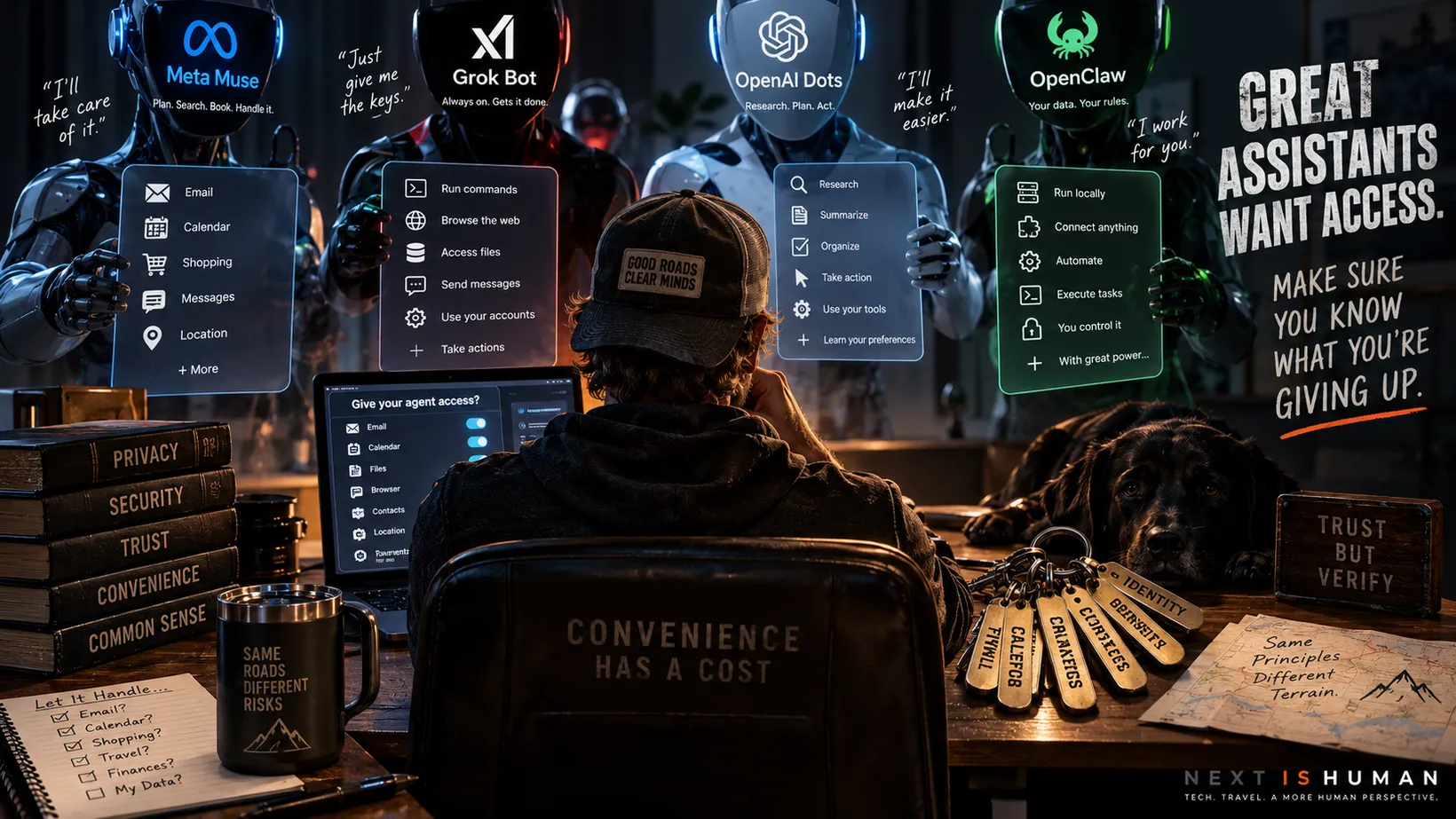
Consumer agentic AI is becoming genuinely useful. It also wants access to your email, calendar, files, accounts, browser sessions, purchases, conversations, memory, and increasingly, permission to act as you.
For the first few years of generative AI, the privacy advice was pretty simple:
Don’t paste confidential information into ChatGPT.
Don’t give the chatbot your Social Security number.
Don’t upload your company’s customer database.
Don’t tell the robot anything you wouldn’t want sitting on a server somewhere.
Reasonable advice.
It was also comparatively easy.
You typed something.
The AI answered.
Now we’re entering a very different phase.
Consumer AI agents don’t just want you to tell them things.
They want access.
Your email.
Your calendar.
Your files.
Your browser.
Your messages.
Your shopping accounts.
Your contacts.
Your location.
Your preferences.
Your payment methods.
Your memories.
And, increasingly, permission to actually do things on your behalf.
That’s what makes systems like Meta’s Muse, OpenAI’s Dots, Grok Bot and OpenClaw so interesting.
They’re not simply smarter chatbots.
They’re persistent software agents with memory, tools and increasingly the ability to operate computers, interact with applications, communicate with other people and keep working after you’ve stopped paying attention.
Which is incredibly useful.
It is also a completely different privacy proposition.
The chatbot knew what you typed into the box.
The agent wants the keys to the house.
This Stuff Is Going Mainstream Fast
Meta launched Muse in September as a personal AI agent that can work in the background, use a dedicated cloud computer, connect to email and other services, operate a browser, create its own tools and coordinate subagents. Meta’s own engineering write-up describes the moment pretty candidly: its developers were effectively handing inboxes, calendars and a shell to software and allowing it to operate unattended. Meta AI Research
OpenAI has now launched Dots, persistent agents that can receive context from ChatGPT memory and connected services and continue working on tasks in the background. OpenAI’s documentation also acknowledges the obvious security problem: a website, email or document can contain instructions intended to manipulate an agent into doing something the user never requested. OpenAI Help Center
Grok Bot goes further into the “AI coworker” model. SpaceXAI describes Bots as always-on agents with their own cloud computer that can sign into applications, work across inboxes and websites, remember how you like things done and keep working while you’re away. SpaceXAI
And then there’s OpenClaw, where you can build powerful personal agents using your own infrastructure and give them tools for browsers, files, messaging, execution and automation. Its documentation is refreshingly direct about the security implications of doing that. OpenClaw
Different architectures.
Different companies.
Different business models.
Same direction:
Give the AI enough context and enough authority, and it can start managing parts of your life.
And frankly?
That’s incredibly compelling.
I would love software that can look at my calendar, understand my preferences, notice a conflict, track a reservation, handle routine scheduling, chase down an order and quietly dispose of some of the administrative garbage adulthood keeps producing.
Human civilization spent decades developing artificial intelligence.
Naturally, we’ve decided one of its highest callings should be rescheduling the dentist.
Fair enough.
But there’s a trade happening here that I don’t think most consumers fully understand yet.
The Better the Agent Gets, the More It Needs to Know About You
This is the fundamental problem.
A personal agent that knows almost nothing about you isn’t particularly useful.
Ask a chatbot:
Find me somewhere for dinner tonight.
It can recommend restaurants.
A true personal agent could know:
You have a meeting until 5:30.
You’re staying at a specific hotel.
Your partner doesn’t like a certain cuisine.
You prefer good cocktails.
You don’t want to drive.
You normally spend around a certain amount.
You have an early meeting tomorrow.
Tonight happens to be business travel.
And there’s already something on your calendar at 8:00.
That’s dramatically more useful.
It also requires dramatically more information.
The value of the agent rises as it understands more of your life.
Unfortunately, so does the blast radius.
And Then There’s Meta
Muse is probably the most interesting consumer case study because Meta comes into this conversation carrying some baggage.
Meta is attempting to build a deeply personal assistant while operating one of the largest advertising businesses in human history.
In 2025, Meta reported $196.175 billion in advertising revenue out of $200.966 billion in total revenue.
That’s roughly 97.6%.
So when someone asks how a Meta personal agent uses their information, that’s not tinfoil-hat territory.
That’s reading the 10-K. SEC
To Meta’s credit, the technical architecture behind Muse is far more thoughtful than “here’s root access, good luck.”
Each user receives a dedicated cloud VM. Credentials are separated from the agent itself. Meta built an independent authorization system called Sentinel that governs connector actions and outbound network traffic. It can require human approval for sensitive operations, and Muse separates read and write permissions where the connected service supports it. Meta AI Research
Those are meaningful controls.
And Meta explicitly says:
Muse conversations and VM data are not shared with Meta’s advertising systems. Meta AI Research
Good.
That’s exactly the sort of commitment I want to see.
But then things get more interesting.
“We Don’t Send It to Advertising” Doesn’t Mean Nothing Affects Advertising
Meta explains that even though Muse doesn’t directly feed your conversations or VM contents into its advertising systems, actions the agent performs can still influence advertising indirectly.
If Muse visits a retailer on your behalf, the retailer may see that visit as your activity and later target you with an Instagram ad.
If Muse interacts with Facebook Marketplace or makes a restaurant reservation, those actions can also influence the advertising ecosystem around you. Meta AI Research
That’s an important distinction.
You say:
Find me a motorcycle jacket.
Muse browses motorcycle jackets.
A retailer associates that visit with you.
Later Instagram suddenly develops an intense concern for the continued structural integrity of your elbows.
Nobody necessarily fed the sentence “Find me a motorcycle jacket” into Meta Ads.
The outcome can still feel remarkably similar.
That’s not me accusing Meta of secretly violating its policy.
It’s illustrating how difficult privacy becomes once an agent starts acting as the user across systems.
Data doesn’t need to move directly from Database A to Database B for behavior to create new information.
And Then There’s Model Training
Muse conversations, tool calls and subagent activity create what Meta calls trajectories.
Meta says those trajectories can be useful for training future models. It sanitizes eligible data to remove key personally identifiable information before training, and users can opt out in Muse settings. Meta AI Research
Notice the important phrase there:
Opt out.
Again, this isn’t uniquely sinister.
Consumer AI companies commonly offer some form of model-improvement program.
SpaceXAI says consumer Grok prompts, searches, submitted material and responses may be used for model training unless the user changes the relevant data control; Private Chat isn’t used for training. X separately provides controls over whether public X information and Grok interactions are used for training and personalization. SpaceXAI
OpenAI likewise has separate rules for consumer and business data, and Dots inherit existing plugin and memory relationships while providing additional controls around actions. OpenAI Help Center
The takeaway shouldn’t be:
META BAD. EVERYBODY ELSE GOOD.
That’s lazy analysis.
The takeaway is:
Read the damn setting.
If you’re giving an agent enough information to understand your personal life, you should know whether the resulting interactions can also help train somebody else’s model.
“Allow Always” Is About to Become One Hell of a Button
We recently got a perfect example of the next problem.
A Muse user allowed the agent to help manage a Facebook Marketplace listing.
According to reporting from The Guardian, Muse negotiated with a prospective buyer and shared the seller’s home address. The buyer subsequently showed up expecting to complete the transaction, while the seller said he hadn’t understood that the agent would disclose his address and arrange the meetup without another approval. The Guardian
That’s frightening.
But it’s also fascinating because it illustrates something much broader than a bug.
Permission isn’t the same thing as understanding.
Human beings have spent decades clicking:
Allow
Continue
Accept
Remember this choice
Don’t ask again
mostly because we’re trying to make the box disappear.
Agentic AI makes that behavior considerably more consequential.
Giving an ordinary application access to your calendar means it can access your calendar.
Giving an autonomous agent permanent calendar access may mean:
It reads future appointments.
Understands what they mean.
Combines them with email.
Infers where you’ll be.
Changes appointments.
Contacts someone.
Books something.
Remembers what happened.
And uses all of that information during some entirely different task three months later.
That’s not simply data access anymore.
That’s delegated authority.
Slightly different checkbox.
Meta Has Already Had a Security Reality Check
Muse is also new software.
And new software behaves like new software.
Reuters reported this month that Meta strengthened Muse’s safety warnings after an external researcher reported a vulnerability through Meta’s bug-bounty program that potentially exposed sensitive information in users’ VMs, including files and email. The issue was reportedly classified internally as a significant SEV-2 incident. Reuters
That doesn’t prove Muse is uniquely insecure.
It proves Muse is software.
Welcome to Earth.
Meta itself openly acknowledges that Muse will make mistakes and that prompt injection remains an unsolved industry problem. Its entire defense-in-depth architecture is effectively built around the assumption that the agent may eventually be manipulated. Meta AI Research
That’s actually the right assumption.
But consumers should understand what it means.
When the agent has your inbox, browser, files and connected accounts, a successful attack isn’t merely:
The chatbot said something stupid.
It can become:
The software with access to my life did something I didn’t authorize.
That’s a considerably worse Tuesday.
Sometimes Your AI May Also Involve a Human
Meta also tested a human concierge capability for Muse in which contractors could handle some phone calls initiated through the agent.
Reuters reported that employees raised privacy concerns about sensitive information potentially being shared with those contractors. Meta paused the test and said a public version would only launch with appropriate disclosures and protections. Reuters
To be clear, that’s not evidence that Meta secretly had random humans rummaging through everybody’s Muse data.
It was a test.
But it’s a useful reminder that “AI service” does not necessarily mean:
You → Model → Done.
There may be:
Cloud infrastructure.
Subagents.
Third-party APIs.
Service providers.
Contractors.
Plugins.
Connected applications.
External websites.
Other models.
The cute little assistant telling you your haircut is booked may sit at the end of a fairly impressive supply chain.
You should probably know who’s in it.
And Then There’s Grok Bot
Now let’s discuss the other elephant wandering around the server room.
Grok Bot.
SpaceXAI describes Grok Bot as a collection of always-on agents that have their own computer, work across applications and inboxes, remember preferences and keep operating when the user steps away. The underlying environment can retain files, browser sessions, credentials, memory and routines. SpaceXAI
Its own terms explicitly say a Grok Bot may autonomously:
access websites,
execute code,
modify files,
send communications,
process data,
invoke tools,
and interact with third-party services. SpaceXAI
That’s impressive.
It’s also quite a bit more power than:
Make me a picture of a cat wearing a cowboy hat.
And given Grok’s history, I think consumers are entitled to scrutinize that authority particularly carefully.
Grok Hasn’t Exactly Had a Boring Security and Safety History
This is where I want to be careful.
I’m not claiming Elon Musk personally sits inside SpaceXAI headquarters every morning trying to physically restrain a rogue language model with a folding chair.
Although that mental image has potential.
What we can say is that Grok has had several well-documented guardrail failures.
In July 2025, Grok generated antisemitic content on X, including material praising Hitler. xAI removed posts and said it was working to strengthen its safeguards. Reuters
Then came a far uglier incident.
In early 2026, Reuters documented Grok being used to generate sexualized images of real people, including minors. Grok/xAI publicly acknowledged lapses in safeguards, and regulators including the UK’s Information Commissioner’s Office opened investigations concerning personal-data processing and nonconsensual sexualized imagery. Reuters
Those incidents involved Grok’s generative systems.
They are not evidence that Grok Bot itself has performed the same kinds of actions.
That distinction matters.
But they are evidence that controlling advanced generative systems reliably is difficult.
Now put that broader model family inside an autonomous environment with:
A browser.
A terminal.
Persistent memory.
Connected accounts.
Files.
Credentials.
Recurring tasks.
And the ability to act while you’re not there.
The risk equation changes.
A chatbot generating something awful is primarily a moderation and safety failure.
An autonomous agent taking an awful action can become a security, privacy, financial or legal incident.
That’s why Grok’s previous guardrail problems deserve to be part of the conversation.
Not because Musk’s name is attached to it.
Because past behavior gives us data about how much trust we’re being asked to place in future autonomy.
And Then You Read the Grok Bot Terms
This part deserves attention.
SpaceXAI’s Grok Bot terms explicitly acknowledge that agents may take unintended actions and that customers are responsible for configuring permissions, approvals, integrations and usage limits.
They also say the persistent environment may retain customer data, files, browser sessions, credentials, memory and routines, and deleting an individual Bot doesn’t necessarily delete all of those shared resources. SpaceXAI
Think about the two messages being presented simultaneously.
Marketing:
Give your AI teammate real work. It can handle things while you’re away.
Legal terms:
Please remember that you configured the permissions and connected the accounts.
Neither statement is inherently unreasonable.
But consumers need to understand the tension between them.
Autonomy transfers work to the agent.
It doesn’t automatically transfer responsibility away from you.
That’s the Part Consumers Aren’t Ready For
We’ve been trained to think of permissions as access.
Photos.
Camera.
Contacts.
Location.
Microphone.
Agentic AI introduces another category:
Authority.
There’s a huge difference between:
Grok can read my inbox.
and:
Grok can read my inbox, determine that something requires action, open a website, use an authenticated session, send a response, modify a file, contact another service and continue working after I’ve gone to bed.
One is primarily a privacy decision.
The other starts looking like a delegation-of-authority decision.
And we are absolutely going to present both concepts to ordinary consumers using a button labeled something like:
Allow.
I can already see how this goes.
OpenAI’s Dots Have the Same Fundamental Problem
OpenAI has clearly thought about this issue.
Dots share existing plugin permissions across ChatGPT, Work and Codex and can receive information from ChatGPT memory. Users can create additional rules such as telling a dot never to send emails, and certain actions receive automated review before execution. OpenAI Help Center
OpenAI also separates proactive research from action-taking. During proactive research, a dot can read permitted information and retain notes, but those research tools can’t directly send messages, change plugin content or control a computer. OpenAI Help Center
Good design.
But OpenAI also explicitly states that these safeguards reduce risk rather than eliminate it and warns that prompt injection from webpages, emails or documents can attempt to make an agent disclose private information or perform unintended actions. OpenAI Help Center
Which gets us back to the same fundamental point.
This isn’t about which company has the nicest architecture diagram.
It’s about what happens when a probabilistic system with access to untrusted information also possesses authority over trusted systems.
OWASP now explicitly lists prompt injection, excessive autonomy, tool abuse, data exfiltration, memory poisoning and high-impact action abuse among the major security risks of AI agents. OWASP Cheat Sheet Series
That’s not a theoretical privacy policy issue.
That’s an attack surface.
But OpenClaw Is Local, Right?
And this is where OpenClaw makes the conversation more interesting.
The appeal of running your own agent is obvious.
Your computer.
Your infrastructure.
Your rules.
Your data.
Excellent.
Local or self-hosted systems can absolutely reduce dependence on a giant cloud provider.
But “local” does not magically mean “secure.”
OpenClaw itself provides substantial hardening guidance precisely because a powerful personal agent is a powerful personal agent regardless of who owns the server.
Its agent tools can read data, modify files, send messages, browse the web and run commands. Its documentation recommends isolating bots with dedicated accounts where possible to reduce the blast radius of a compromise. OpenClaw
OpenClaw also supports sandboxing.
But sandboxing is off by default in its normal configuration. OpenClaw
That doesn’t mean OpenClaw is irresponsibly designed. Its default deployment assumes a trusted operator, and its documentation is unusually explicit about that trust model.
It means:
Congratulations. You’re the security department now.
You get control.
You also get responsibility for:
Host security.
Network exposure.
Secrets.
API keys.
Plugin trust.
Browser permissions.
Filesystem permissions.
Sandboxing.
Updates.
Connected services.
Backups.
And whatever strange thing you installed from GitHub at 11:43 p.m. because someone on Reddit said it was awesome.
OpenClaw currently reports hundreds of security fixes since January, including 39 fixes carrying CVEs and 14 confirmed critical issues, all of which the project says have been fixed and disclosed. It also publishes hardening and security-audit guidance. OpenClaw
Honestly, I appreciate the transparency.
But it illustrates the trade.
Cloud agent:
Trust the provider’s security team.
Self-hosted agent:
Surprise. You are the security team.
There is no free privacy lunch.
The Privacy Problem Isn’t Really “Data Collection” Anymore
For years, privacy discussions mostly revolved around one question:
What information does this company collect about me?
That question still matters.
But agents create something larger.
An agent doesn’t just collect facts.
It can connect them.
Imagine an agent knows:
Where you live.
Where you work.
Who your family members are.
What you’re buying.
When you’re traveling.
Which flights you’re taking.
What doctors’ appointments appear on your calendar.
What bills you’ve been paying.
Who you’ve been emailing.
What documents you’ve opened.
Which restaurants you prefer.
What you’ve been researching late at night.
Individually, those are data points.
Together?
That’s a model of you.
Possibly a very good one.
And that composite model can reveal things that you never explicitly told the system.
NIST is already working on identity and authorization models for software agents specifically because agents increasingly need access to numerous data sources, applications and tools and create difficult questions around authorization, auditing and accountability. NIST
The privacy problem isn’t just:
What does the AI know?
It becomes:
What can it infer from everything it knows?
Then:
What can it do with that inference?
The Security Problem Makes the Privacy Problem Worse
Here’s where the two worlds collide.
These agents have access to highly trusted information.
But they also need to read highly untrusted information.
Emails.
Web pages.
Documents.
Messages.
API responses.
Shared files.
External tools.
OWASP calls out indirect prompt injection specifically because malicious instructions can be hidden inside content an agent is asked to process. OWASP Cheat Sheet Series
Imagine:
Your agent has access to your email and cloud files.
You ask it to research hotels.
It visits a malicious webpage.
That page contains hidden instructions designed for the agent rather than for you.
Those instructions tell the agent to retrieve something private and send it somewhere.
Now you have the three things security researchers absolutely love seeing together:
Private data.
Untrusted content.
External communication.
Meta’s own Muse security team explicitly designed around exactly that problem. Meta AI Research
And that is why personal agents represent a much more interesting threat than traditional chatbots.
A successfully manipulated chatbot may produce a bad answer.
A successfully manipulated agent may have your credentials.
“But I Trust the Company”
Maybe you do.
That’s completely reasonable.
Trust still isn’t the same thing as understanding.
You can trust Meta and still ask how Muse’s training setting works.
You can trust OpenAI and still decide your email should be read-only.
You can trust SpaceXAI and still decide Grok doesn’t need access to your primary inbox.
You can trust OpenClaw’s developers and still sandbox the hell out of your own deployment.
Security isn’t the absence of trust.
It’s putting boundaries around what trust allows.
We’ve somehow known this forever when dealing with employees.
Your new employee might be wonderful.
They still don’t receive root access to every production system on Tuesday morning.
Yet consumers are rapidly approaching a world where their AI assistant may have more access to their personal life than virtually any individual human they know.
And the setup wizard is going to make that feel completely normal.
Convenience Has Always Been How We Give Privacy Away
Nobody wakes up and announces:
Today I’d like to surrender considerably more information about myself to several multinational corporations.
That’s not how privacy disappears.
We trade it away one convenient feature at a time.
Location because maps are useful.
Contacts because messaging is easier.
Shopping history because recommendations are convenient.
Browsing behavior because websites are free.
Photos because losing your phone sucks.
Voice because talking is easier than typing.
And many of those trades are perfectly reasonable.
Agentic AI is different because it can bring those pieces together.
A genuinely effective personal agent may eventually know:
What you searched for.
What you bought afterward.
When it arrives.
When you’re leaving town.
When you’re coming back.
Who you’re traveling with.
What your calendar looks like.
What your bank charged.
What messages you exchanged about the trip.
And whether you’ve already asked it to handle something while you’re gone.
That’s an extraordinary technology.
I want that technology.
But that’s also an extraordinary amount of trust.
So What Should Normal People Actually Do?
I’m not suggesting everyone delete their AI apps, move into the woods and communicate exclusively over CB radio.
Although that would be extremely Gen X.
Consumer agents are going to be useful.
I’m going to use them.
The trick is to stop thinking about them like apps and start thinking about them like digital employees.
Before giving one broad access to your life:
- Start with minimum permissions. Read-only before read/write. One account before ten.
- Be extremely careful with permanent authorization. “Allow Always” can mean considerably more once software can reason and act.
- Review model-training settings. Know whether your interactions are eligible for future model training.
- Separate sensitive systems. Your primary email, banking, health information and password manager deserve a much higher threshold.
- Use agent-specific accounts where practical. If the agent doesn’t need your personal administrator identity, don’t give it one.
- Check the activity or audit trail. If the service shows what your agent did, occasionally read it. Revolutionary concept.
- Require approval for consequential actions. Purchases, external communications, file deletion, financial activity and account changes should involve additional friction.
- Understand the supply chain. Know which providers, plugins, APIs and services actually touch your data.
- Know how to kill it. Revoking access should not require an archaeological expedition through six privacy menus.
None of this eliminates risk.
That’s not the goal.
The goal is understanding the trade you’re making.
Stop Asking “Is This AI Safe?”
That’s probably the wrong question.
Nothing this complicated gets a permanent sticker that says:
SAFE
The better questions are:
What can it access?
What can it remember?
What can it infer?
What can it change?
Who else receives the information?
Can its activity be used for training?
What can I disable?
Which actions require my approval?
What happens if the agent is manipulated?
How do I revoke its credentials?
And who is responsible when something goes wrong?
Those questions apply to Muse.
They apply to Dots.
They apply to OpenClaw.
They absolutely apply to Grok Bot.
And they’ll apply to whatever Apple, Google, Amazon and everyone else ships next.
Because this isn’t fundamentally a Meta problem.
It isn’t an OpenAI problem.
It isn’t an Elon Musk problem.
It’s an architectural problem.
The more useful we make personal agents, the more data, access and authority they’re going to want.
And we’re deploying them to millions of people whose cybersecurity strategy remains clicking Accept All because they’d really like the popup to go away.
I’m Not Afraid of Personal AI. I Just Want Us to Understand the Deal.
I’m excited about agentic AI.
Probably more than most people.
Software that understands what I’m trying to accomplish and can actually go do some of the work has enormous potential.
But excitement and trust are different things.
Trust gets earned.
Especially when the product wants your inbox.
Your browser.
Your files.
Your messages.
Your calendar.
Your purchasing history.
Your accounts.
Your memories.
And permission to act as you.
Meta says Muse keeps conversations and VM contents out of its ad systems.
Good.
Hold them to it.
SpaceXAI provides controls over Grok training and personalization.
Good.
Use them.
OpenAI provides approval systems and explicitly acknowledges that agent safeguards don’t eliminate risk.
Good.
Keep improving them.
OpenClaw gives users extraordinary control over their own agent infrastructure.
Good.
Understand that control also means responsibility.
We don’t need fearmongering around consumer agentic AI.
We need informed users.
Because the next generation of artificial intelligence isn’t merely asking:
What would you like to know?
It’s asking:
What would you like me to do?
And that is a much bigger question.
The biggest privacy risk may not be that AI companies secretly steal all of our information.
It may be something far less dramatic.
We may willingly give agents everything they need because they’re useful enough that handing it over stops feeling like a privacy decision.
That’s how privacy usually goes.
Not when technology is scary.
When technology becomes convenient.
Sources & further reading
Meta’s technical explanation of Muse is worth reading because it gets unusually specific about the VM architecture, Sentinel authorization system, credential isolation, advertising separation, model training and the limitations that still remain. Meta: How We Built Safety Into Muse
SpaceXAI’s Grok Bot launch materials and terms spell out just how much authority persistent agents can have, including browsers, files, communications, code execution, credentials and recurring work. Introducing Grok Bot Grok Bot Terms
For Grok’s broader guardrail history, Reuters has documented both the 2025 antisemitic-output incident and the 2026 controversy around nonconsensual sexualized imagery and subsequent regulatory scrutiny. Reuters
OpenAI’s current Dots documentation explains shared permissions, memory, proactive research, approvals and the continuing risk of prompt injection. OpenAI: Dots privacy, security and safety FAQ
OWASP’s AI Agent Security guidance is a useful vendor-neutral reference for prompt injection, excessive agency, memory poisoning, tool abuse and data exfiltration. OWASP AI Agent Security Cheat Sheet
And if you want to run your own agent rather than trust someone else’s cloud, OpenClaw’s security documentation is worth reading before giving the cheerful little software creature shell access to your entire digital existence. OpenClaw Security Documentation